Sci-art competition: The results are in!
The winners to the anomalous mathematical patterns sci-art competition have just been announced. They showcase the role that maths can have in the creation of some really beautiful and thought-provoking art.
Art has always had great ties to mathematics. Artists throughout history have been using mathematics as a muse, one thinks of, for example, M. C. Escher taking inspiration from the great geometer H.S.M. Coxeter.
You can listen to Codina talk about the competition in our podcast!
Codina Cotar, who helped in the orchestration of the competition, has always believed that maths need not be considered as abstract and disconnected to the real world as some people believe it be. One of the possible themes that artists could draw from in the competition was randomness in probability theory. Speaking about this she said "people normally think mathematics and probability theory are these abstract ideas. However, what we really wanted to let people discover is that mathematics isn't abstract, probability isn't abstract. It's not something just disconnected from everyday life, that it's all around us, that it's somehow part of the fabric of life."
The competition received 528 eligible entries, and not all of these were created with mathematics in mind. Codina Cotar tells us "there are many who had...already produced the art and not realised that it was connected to mathematics until they had looked at the contest page." It is quite lovely to see the beauty of mathematics arising in works where people haven't intended to create it.
The competition was split into three categories: photograph, painting, film, print, animation; textile, sculpture or other medium (such as 3D printing, laser cutting, CNC routing); and AI and computer-generated art, which could also contain digitally or otherwise enhanced or altered photos. Prizes of £750, £300 and £150 were awarded to the top 3 entries in each category. Further monetary prizes were awarded via a public vote (that saw over 20,000 voters!) and a programme participants' choice award. We now discuss some of the winners.
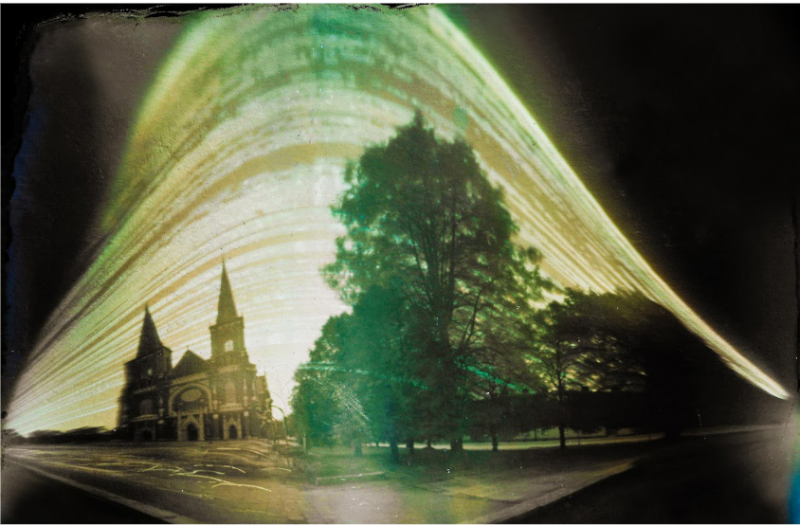
Winner of photograph, painting, film, print, animation: Piotr Cieślak
Piotr Cieślak piece made use of solarigraphy. This is a technique that uses photographic paper without chemical processing, a scanner and simple pinhole camera. By such simple means, he was able to capture the randomness of the interaction between something deterministic, such as the motion of the Sun, with unpredictable factors, such as the weather and the imperfections of a handmade camera. These add noise to the photographs which aren't considered as imperfections (as they might normally be) so much as integral to the piece of art itself.
Cieślak explains on the competition website: "Through this approach, I aim to explore the inherent unpredictability of natural systems and the beauty that emerges from it. Solarigraphy serves as a bridge between art and science, illustrating complex patterns and highlighting the relationship between mathematical abstraction and the organic randomness of the physical world. This work invites viewers to reflect on the hidden structures and anomalies that govern our universe."
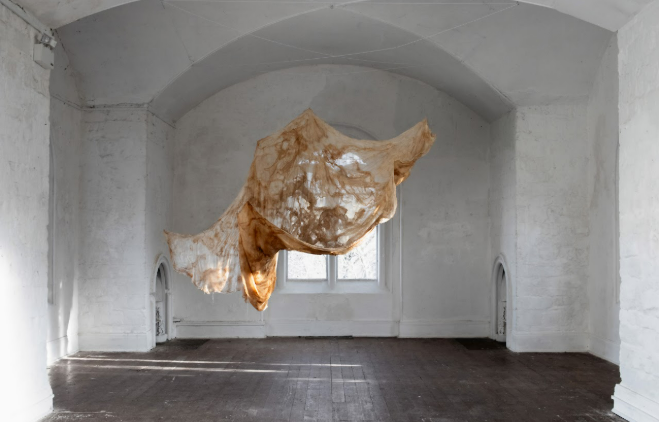
Winner of textile, sculpture or other medium (such as 3D printing, laser cutting, CNC routing): Lilia Bakanova
A description of the Aral Sea in Central Asia is usually written in the past tense. In the mid 1960s, it was one of the largest inland lakes in the world. Alas, now, due to Soviet irrigation projects, it has largely dried up into desert, leaving behind a skeleton scarred by sediment and salt, rippled by boundary layers and fluid mechanics, all of course governed by mathematics. The work was created with silk and cotton, intentionally chosen as both materials were grown with water that could have fed the Aral Sea. The piece is hung unevenly from the ceiling were light from nearby windows pierces it, making its randomness beautiful, its chaos candescent.
Bakanova writes of her piece: "Veining, diffusion, and rippling are not merely aesthetic; they embody material boundary effects, visualising the invisible dynamics of loss and transformation. Where fluid dynamics seeks to capture flow in motion, my work holds stillness, giving form to what once moved but no longer can. Instead of modelling the system, I reveal its residue—where movement faded, and patterns dissolved into layered stillness."
Winner of AI and computer-generated art, which could also contain digitally or otherwise enhanced or altered photos: Ao Lei
Of the three winners, this piece is perhaps the one whose creation is most directly informed by mathematics. At the forefront of the piece is the sine-Gordon equation:
$\frac{\partial^2 \varphi}{\partial t^2} - \frac{\partial^2 \varphi}{\partial x^2} - \frac{\partial^2 \varphi}{\partial y^2}+ \sin \varphi = 0$
This (perhaps intimidating) equation is important in quantum mechanics and quantum field theory, cropping up in systems like magnetic materials and crystal structures. Ao Lei's video projects the solution of this equation onto a curved 3-D space. The results are stunning.
Ao Lei says about his work: "The installation occupies a liminal space between rigorous physics and pure abstraction, inviting viewers to contemplate the aesthetic dimension of mathematical structures that shape our understanding of reality."
Ao's work based on the stereographic sine-Gordon equation.
Other pieces
When we asked Codina Cotar to pick a favourite to talk about she told us "It's hard to pick a favourite, they're so wonderful, so many of them". She is quite right, please enjoy looking through the rest of the entries here.
About the Author
Ben Watkins finished his 4th year of mathematics at Cambridge in 2025. His interests include theoretical physics, quantum computation, and mathematical communication: sharing the joy of maths with a wider audience!
This content forms part of our collaboration with the Isaac Newton Institute for Mathematical Sciences (INI) – you can find all the content from the collaboration here.
The INI is an international research centre and our neighbour here on the University of Cambridge's maths campus. It attracts leading mathematical scientists from all over the world, and is open to all. Visit www.newton.ac.uk to find out more.
