

Home
plus.maths.org

Secondary menu

  • My list
  • About Plus
  • Sponsors
  • Subscribe
  • Contact Us
  • Log in
  • Main navigation

  • Home
  • Articles
  • Collections
  • Podcasts
  • Maths in a minute
  • Puzzles
  • Videos
  • Topics and tags
  • For

    • cat icon
      Curiosity
    • newspaper icon
      Media
    • graduation icon
      Education
    • briefcase icon
      Policy

    Popular topics and tags

    Shapes

    • Geometry
    • Vectors and matrices
    • Topology
    • Networks and graph theory
    • Fractals

    Numbers

    • Number theory
    • Arithmetic
    • Prime numbers
    • Fermat's last theorem
    • Cryptography

    Computing and information

    • Quantum computing
    • Complexity
    • Information theory
    • Artificial intelligence and machine learning
    • Algorithm

    Data and probability

    • Statistics
    • Probability and uncertainty
    • Randomness

    Abstract structures

    • Symmetry
    • Algebra and group theory
    • Vectors and matrices

    Physics

    • Fluid dynamics
    • Quantum physics
    • General relativity, gravity and black holes
    • Entropy and thermodynamics
    • String theory and quantum gravity

    Arts, humanities and sport

    • History and philosophy of mathematics
    • Art and Music
    • Language
    • Sport

    Logic, proof and strategy

    • Logic
    • Proof
    • Game theory

    Calculus and analysis

    • Differential equations
    • Calculus

    Towards applications

    • Mathematical modelling
    • Dynamical systems and Chaos

    Applications

    • Medicine and health
    • Epidemiology
    • Biology
    • Economics and finance
    • Engineering and architecture
    • Weather forecasting
    • Climate change

    Understanding of mathematics

    • Public understanding of mathematics
    • Education

    Get your maths quickly

    • Maths in a minute

    Main menu

  • Home
  • Articles
  • Collections
  • Podcasts
  • Maths in a minute
  • Puzzles
  • Videos
  • Topics and tags
  • Audiences

    • cat icon
      Curiosity
    • newspaper icon
      Media
    • graduation icon
      Education
    • briefcase icon
      Policy

    Secondary menu

  • My list
  • About Plus
  • Sponsors
  • Subscribe
  • Contact Us
  • Log in
  • Mike Hill

    Topological data analysis with Michael Hill

    8 October, 2025

    The mathematical area of topology is all about figuring out what truly defines a shape. Famously, topologists consider a coffee cup to be the same as a doughnut because one can be turned into the other without cutting or gluing — what defines and relates these two shapes for a topologist is that they have a single hole.

    As you might imagine, if you have ever tried to drink coffee out of a doughnut, topology has traditionally been part of pure mathematics. Topological data analysis (TDA), however, opens up a world of applications by applying ideas from topology to vast data sets, helping us to understand their "shape" and draw out important features.

    In this episode of Maths on the Move we talk to algebraic topologist Michael Hill about some of the fascinating uses of topological data analysis — from understanding breast cancer to making sure that voting is fair.

    We talked to Michael after he gave a brilliant Rothschild lecture at the Isaac Newton Institute for Mathematical Sciences (INI) in Cambridge. He was at the INI to attend the research programme Equivariant homotopy theory in context.

    To find out more about the topics mentioned in this podcast see:

    • Maths in a minute: Topology — a quick introduction to topology.
    • Understanding life with topology — a quick introduction to TDA and some of its uses.
    • Euromaths: Heather Harrington — An episode of our Maths on the move podcast giving and introduction to topological data analysis.
    • Watch Michael Hill's Rothschild lecture at the INI.
    • Topology based data analysis identifies a subgroup of breast cancers with a unique mutational profile and excellent survival - The paper by Nicolau, Levine and Carlesson, mentioned by Michael in the podcast, which uses TDA to identify a novel type of breast cancer.
    • The Data and Democracy Lab — mentioned by Michael in the podcast.

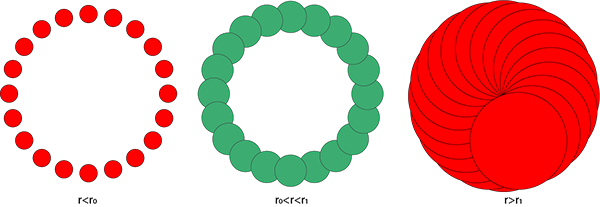
    Also, here is an image illustrating the intuition behind topological data analysis. As discs drawn around a bunch of points arranged in a circle increase in radius, they eventually overlap to form a ring, and later overlap to form a single blob.
    circles


    This podcast forms part of our collaboration with the Isaac Newton Institute for Mathematical Sciences (INI) – you can find all the content from the collaboration here.

    The INI is an international research centre and our neighbour here on the University of Cambridge's maths campus. It attracts leading mathematical scientists from all over the world, and is open to all. Visit www.newton.ac.uk to find out more.

    INI logo
    • Log in or register to post comments
    You can listen to the podcast using the player above, and you can listen and subscribe to our podcast through Apple Podcasts, Spotify and through most other podcast providers via podbean.

    You might also like

    article
    Example of the use of TDA

    Understanding life with topology

    Can topological data analysis create a revolution in the life sciences?

    podcast
    Heather Harrington

    Euromaths: Heather Harrington

    We all know what data is and you might know what topology is. But what is topological data analysis? We find out with Heather Harrington.

    article

    Maths in a minute: Topology

    When you let go of the notions of distance, area, and angles, all you are left with is holes.

    Read more about...

    INI
    topology
    topological data analysis
    University of Cambridge logo

    Plus is part of the family of activities in the Millennium Mathematics Project.
    Copyright © 1997 - 2025. University of Cambridge. All rights reserved.

    Terms