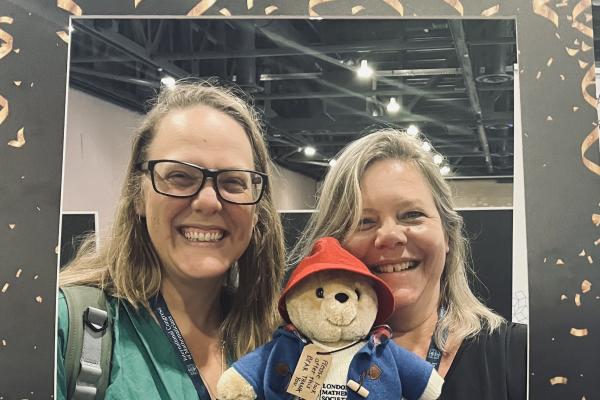
ICM 2026: A postcard from Philadelphia
Hot weather, cold air conditioning, and fantastic mathematics — we report on our experience at this year's International Congress of Mathematicians.
Carola-Bibiane Schönlieb is a Reader in Applied and Computational Analysis at the Department of Applied Mathematics and Theoretical Physics, University of Cambridge. There, she is head of the Cambridge Image Analysis group, Director of the Cantab Capital Institute for Mathematics of Information, Co-Director of the EPSRC Centre for Mathematical and Statistical Analysis of Multimodal Clinical Imaging, and since 2011 a fellow of Jesus College, Cambridge. Her current research interests focus on variational methods and partial differential equations for image analysis, image processing and inverse imaging problems.
Hot weather, cold air conditioning, and fantastic mathematics — we report on our experience at this year's International Congress of Mathematicians.
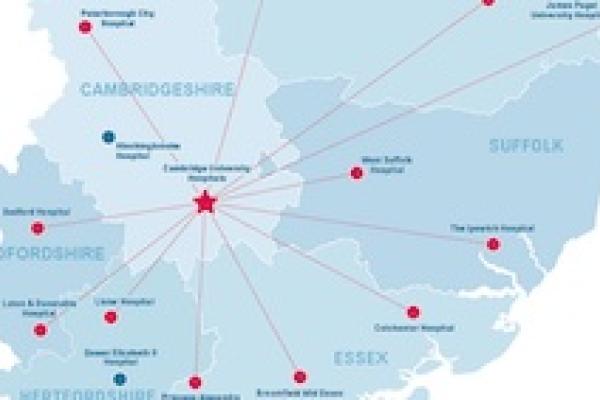
The BloodCounts! project is gearing up towards one of the largest-scale applications yet of machine learning in medicine and healthcare.
We ask the INTEGRAL team about their innovative machine learning approaches to understanding remotely gathered images, and the significant impact these technologies can have on the world.
New techniques in artificial intelligence are helping assess the diversity of forests.
The organisers of a new INI programme explain why we need to know more about the maths behind machine learning and deep neural networks.
Taming big data – Carola-Bibiane Schönlieb tells us about a new institute researching the mathematics of information
From cancer treatments to counting trees: the maths behind image analysis makes it all possible.
In 1979 decorating work in a house in Vienna revealed a set of medieval frescoes depicting a cycle of songs by a 13th century poet, who was particularly fond of satirising the erotic relationships between knights and peasant maidens. The frescoes are of great historical significance, but they are badly damaged. In this article Carola Schönlieb explores how mathematicians use the heat equation to fill in the gaps.