
News story
Article
Mathematical mysteries: Getting the most out of life - Part 1
There are many sorts of games played in a "bunco booth", where a trickster or sleight-of-hand expert tries to relieve you of your money by getting you to place bets - on which cup the ball is under, for instance, or where the queen of spades is. Lots of these games can be analysed using probability theory, and it soon becomes obvious that the games are tipped heavily in favour of the trickster!
Article
Getting the most out of life - Part 2
The idea is this. To start with, you will choose an envelope at random, say by tossing a coin, and look at its contents, which is a cheque for some number - say n. (By randomising like this, you can be sure I haven't subconsciously induced you to prefer one envelope or the other.) You want to make sure that the bigger the number is, the more likely you are to keep it, in other words, the less likely you are to swap.
Puzzle
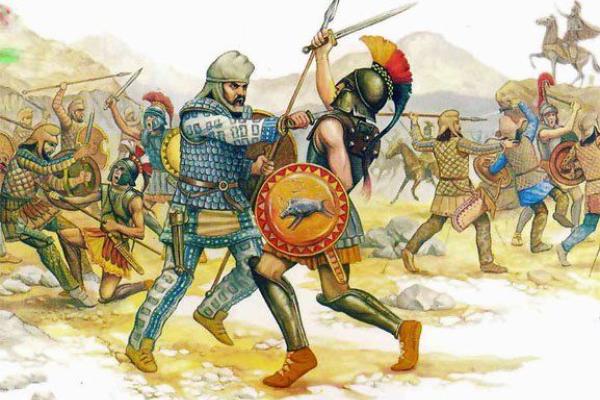
Spies Passing in the Night
A greek soldier, and a persion soldier walk into a battle...
Article
Friends and strangers
Sometimes a mathematical object can be so big that, however disorderly we make the object, areas of order are bound to emerge. Imre Leader looks at the colourful world of Ramsey Theory.
News story
Playing the laying a pale egg game
Some birds, including sparrows and herring gulls, lay their eggs so that the last one to come out is a shade or two lighter than the others. You might suppose that laying eggs requires some effort and that the colour of the last egg is a sign of an exhausted mother. But this practice might be of evolutionary advantage.
Article
Model Trains
As customers will tell you, overcrowding is a problem on trains. Fortunately, mathematical modelling techniques can help to analyse the changing demands on services through the day. Tim Gent explains.
Article
Mathematical mysteries: What colour is my hat?
This is a game played between a team of 3 people (Ann, Bob and Chris, say), and a TV game show host. The team enters the room, and the host places a hat on each of their heads. Each hat is either red or blue at random (the host tosses a coin for each team-member to decide which colour of hat to give them). The players can see each others' hats, but no-one can see their own hat.
Article
Measure for measure
Can you imagine objects that you can't measure? Not ones that don't exist, but real things that have no length or area or volume? It might sound weird, but they're out there. Andrew Davies gives us an introduction to Measure Theory.
Article
Mathematical mysteries: Zeno's Paradoxes
The paradoxes of the philosopher Zeno, born approximately 490 BC in southern Italy, have puzzled mathematicians, scientists and philosophers for millennia. Although none of his work survives today, over 40 paradoxes are attributed to him which appeared in a book he wrote as a defense of the philosophies of his teacher Parmenides.
Article
Maths on the tube
During World Mathematical Year 2000 a sequence of posters were displayed month by month in the trains of the London Underground aiming to stimulate, fascinate - even infuriate passengers! Keith Moffatt tells us about three of the posters from the series.
Article
Cars in the next lane really do go faster
Yes, you were right to wish you were in the other lane during this morning's commute! Nick Bostrom tells why we're usually caught in the slow lane.