
Home
plus.maths.org

Secondary menu

  • My list
  • About Plus
  • Sponsors
  • Subscribe
  • Contact Us
  • Log in
  • Main navigation

  • Home
  • Articles
  • Collections
  • Podcasts
  • Maths in a minute
  • Puzzles
  • Videos
  • Topics and tags
  • For

    • cat icon
      Curiosity
    • newspaper icon
      Media
    • graduation icon
      Education
    • briefcase icon
      Policy

    Popular topics and tags

    Shapes

    • Geometry
    • Vectors and matrices
    • Topology
    • Networks and graph theory
    • Fractals

    Numbers

    • Number theory
    • Arithmetic
    • Prime numbers
    • Fermat's last theorem
    • Cryptography

    Computing and information

    • Quantum computing
    • Complexity
    • Information theory
    • Artificial intelligence and machine learning
    • Algorithm

    Data and probability

    • Statistics
    • Probability and uncertainty
    • Randomness

    Abstract structures

    • Symmetry
    • Algebra and group theory
    • Vectors and matrices

    Physics

    • Fluid dynamics
    • Quantum physics
    • General relativity, gravity and black holes
    • Entropy and thermodynamics
    • String theory and quantum gravity

    Arts, humanities and sport

    • History and philosophy of mathematics
    • Art and Music
    • Language
    • Sport

    Logic, proof and strategy

    • Logic
    • Proof
    • Game theory

    Calculus and analysis

    • Differential equations
    • Calculus

    Towards applications

    • Mathematical modelling
    • Dynamical systems and Chaos

    Applications

    • Medicine and health
    • Epidemiology
    • Biology
    • Economics and finance
    • Engineering and architecture
    • Weather forecasting
    • Climate change

    Understanding of mathematics

    • Public understanding of mathematics
    • Education

    Get your maths quickly

    • Maths in a minute

    Main menu

  • Home
  • Articles
  • Collections
  • Podcasts
  • Maths in a minute
  • Puzzles
  • Videos
  • Topics and tags
  • Audiences

    • cat icon
      Curiosity
    • newspaper icon
      Media
    • graduation icon
      Education
    • briefcase icon
      Policy

    Secondary menu

  • My list
  • About Plus
  • Sponsors
  • Subscribe
  • Contact Us
  • Log in
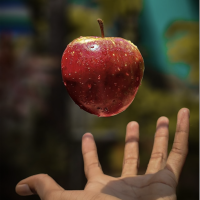
  • Apple falling into an outstretched hand

    Maths in a minute: Newton's law of universal gravitation

    27 April, 2026

    Isaac Newton first published his law of universal gravitation in 1687 as part of his monumental work Philosophiæ Naturalis Principia Mathematica (Latin for "Mathematical Principles of Natural Philosophy"). According to legend he was inspired to think about gravity while watching an apple fall from a tree and wondering why it didn't fall upwards or sideways.

    According to Newton's theory, gravity is a force that works between two objects. If you have the Earth and the Sun, for example, the Earth feels a force that is exerted by the Sun, and in turn the Sun feels the same force, exerted by the Earth.

    The magnitude $F$ of this force is given by the so-called inverse square law $$F=G\frac{m_1 m_2}{r^2},$$ where $G$ is a number known as the gravitational constant, $r$ is the distance between the centres of the two objects, and $m_1$ and $m_2$ are their respective masses.
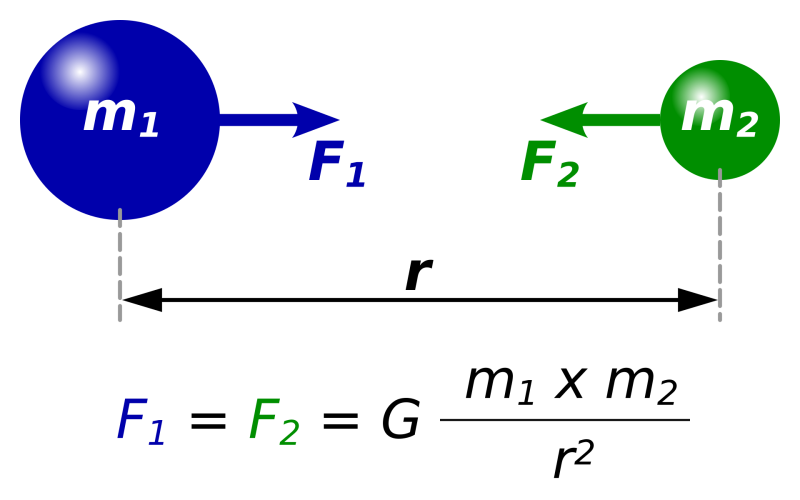
    A diagram explaining the mechanisms of Newton's law of universal gravitation. Further details at the link in caption
    The gravitational interaction of two spherical bodies according to Newton. Image: Dennis Nilsson, CC BY 3.0

    The forces experienced by the two objects may be equal in magnitude, but the resulting motion is not the same for the two bodies. According to Newton's second law of motion, the magnitude of the acceleration a body experiences when it is subjected to a force is equal to the magnitude of the force divided by the body's mass. Since the Sun's mass is large, the acceleration it experiences due to the Earth's gravitational pull is negligible compared to that experienced by the much less massive Earth. That's why the Sun remains more or less stationary, while the Earth is forced on an orbit around it.


    Newton's theory of gravity is remarkably accurate when it comes to most practical purposes. However, it was later superseded by Einstein's theory of gravity, called the general theory of relativity. You can find out more about that in this article.


    About this article

    This content forms part of our collaboration with the Isaac Newton Institute for Mathematical Sciences (INI) – you can find all the content from the collaboration here.

    The INI is an international research centre and our neighbour here on the University of Cambridge's maths campus. It attracts leading mathematical scientists from all over the world, and is open to all. Visit www.newton.ac.uk to find out more.

    Isaac Newton Institute Logo
    • Log in or register to post comments

    You might also like

    article

    Maths in a minute: Einstein's general theory of relativity

    What would happen if the Sun suddenly exploded? Einstein wondered the same thing, and completely changed our understanding of the Universe.
    article
    newton

    Maths in a minute: Newton's laws of motion

    We've been dabbling a lot in the mysterious world of quantum physics lately, so to get back down to Earth we thought we'd bring you reminder of good old classical physics.

    news

    How does gravity work?

    And what are gravitational waves?

    Read more about...

    gravity
    Maths in a minute
    Isaac Newton
    Newtonian mechanics
    INI

    Our Podcast: Maths on the Move

    Our Maths on the Move podcast brings you the latest news from the world of maths, plus interviews and discussions with leading mathematicians and scientists about the maths that is changing our lives.

    Apple Podcasts
    Spotify
    Podbean

    Plus delivered to you

    Keep up to date with Plus by subscribing to our newsletter or following Plus on X or Bluesky.

    University of Cambridge logo

    Plus is part of the family of activities in the Millennium Mathematics Project.
    Copyright © 1997 - 2026. University of Cambridge. All rights reserved.

    Terms