Home
plus.maths.org

Secondary menu

  • My list
  • About Plus
  • Sponsors
  • Subscribe
  • Contact Us
  • Log in
  • Main navigation

  • Home
  • Articles
  • Collections
  • Podcasts
  • Maths in a minute
  • Puzzles
  • Videos
  • Topics and tags
  • For

    • cat icon
      Curiosity
    • newspaper icon
      Media
    • graduation icon
      Education
    • briefcase icon
      Policy

    Popular topics and tags

    Shapes

    • Geometry
    • Vectors and matrices
    • Topology
    • Networks and graph theory
    • Fractals

    Numbers

    • Number theory
    • Arithmetic
    • Prime numbers
    • Fermat's last theorem
    • Cryptography

    Computing and information

    • Quantum computing
    • Complexity
    • Information theory
    • Artificial intelligence and machine learning
    • Algorithm

    Data and probability

    • Statistics
    • Probability and uncertainty
    • Randomness

    Abstract structures

    • Symmetry
    • Algebra and group theory
    • Vectors and matrices

    Physics

    • Fluid dynamics
    • Quantum physics
    • General relativity, gravity and black holes
    • Entropy and thermodynamics
    • String theory and quantum gravity

    Arts, humanities and sport

    • History and philosophy of mathematics
    • Art and Music
    • Language
    • Sport

    Logic, proof and strategy

    • Logic
    • Proof
    • Game theory

    Calculus and analysis

    • Differential equations
    • Calculus

    Towards applications

    • Mathematical modelling
    • Dynamical systems and Chaos

    Applications

    • Medicine and health
    • Epidemiology
    • Biology
    • Economics and finance
    • Engineering and architecture
    • Weather forecasting
    • Climate change

    Understanding of mathematics

    • Public understanding of mathematics
    • Education

    Get your maths quickly

    • Maths in a minute

    Main menu

  • Home
  • Articles
  • Collections
  • Podcasts
  • Maths in a minute
  • Puzzles
  • Videos
  • Topics and tags
  • Audiences

    • cat icon
      Curiosity
    • newspaper icon
      Media
    • graduation icon
      Education
    • briefcase icon
      Policy

    Secondary menu

  • My list
  • About Plus
  • Sponsors
  • Subscribe
  • Contact Us
  • Log in
  • Podcast poster for Meet a Mathematical Family

    Meet a Mathematical Family

    11 August, 2026

    He asked me this question because I'm his sister and he loves me. 

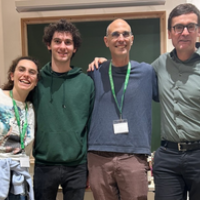
    Mathematics can often be seen as a solitary endeavour, but as this quote from one of our latest podcast guests show, that is far from the truth. In this episode, we learn how a new proof has developed from one young mathematician talking to his sister – and then collaborating with their father and close family friend. We spoke to Roman Sauer and Uri Bader – and Uri’s two children Saar and Shaked – after they had attended a residential research programme at the Isaac Newton Institute where they had worked together and proved a rigidity result around symmetries and group theory. We spoke to all four of them to understand the result, what it was like working together, and how they each got into maths. 

    Please note, this episode includes more technical mathematical descriptions than is standard for our podcasts so you may want a strong cup of coffee before you dive in!

    Maths on the Move, is the podcast from plus.maths.org. We speak to researchers from the frontiers of mathematical science so you can connect with the maths that shapes and explains our world. Hosted by Plus editors Rachel Thomas and Marianne Freiberger.


    Isaac Newton Institute Logo

    This podcast forms part of our collaboration with the Isaac Newton Institute for Mathematical Sciences (INI) – you can find all the content from the collaboration here.

    The INI is an international research centre and our neighbour here on the University of Cambridge's maths campus. It attracts leading mathematical scientists from all over the world, and is open to all. Visit www.newton.ac.uk to find out more.

    • Log in or register to post comments
    You can listen to the podcast using the player above, and you can listen and subscribe to our podcast through Apple Podcasts, Spotify and through most other podcast providers via podbean.

    You might also like

    podcast
    Justin Chen

    What are groups and what are they good for?

    Groups are staples in mathematics and group theory is often described as the study of symmetry. But what does that mean? Find out with Justin Chen!

    package
    different shapes

    Groups: The basics

    Group theory is the mathematics of symmetry and structure. On this page, find out what a group is and how to think about them.

    article
    Spinning Top

    Maths in a Minute: Group actions

    What exactly do we mean when we say group theory is the study of symmetry? Group actions make precise what it means for a group to act by symmetries on an object.

    Read more about...

    group theory
    symmetry
    proof

    Plus delivered to you

    Keep up to date with Plus by subscribing to our newsletter or following Plus on X, Bluesky, Facebook or LinkedIn.

    University of Cambridge logo
    Twitter / X logo Bluesky logo LinkedIn logo

    Plus is part of the family of activities in the Millennium Mathematics Project.
    Copyright © 1997 - 2026. University of Cambridge. All rights reserved.

    Terms