
Home
plus.maths.org

Secondary menu

  • My list
  • About Plus
  • Sponsors
  • Subscribe
  • Contact Us
  • Log in
  • Main navigation

  • Home
  • Articles
  • Collections
  • Podcasts
  • Maths in a minute
  • Puzzles
  • Videos
  • Topics and tags
  • For

    • cat icon
      Curiosity
    • newspaper icon
      Media
    • graduation icon
      Education
    • briefcase icon
      Policy

    Popular topics and tags

    Shapes

    • Geometry
    • Vectors and matrices
    • Topology
    • Networks and graph theory
    • Fractals

    Numbers

    • Number theory
    • Arithmetic
    • Prime numbers
    • Fermat's last theorem
    • Cryptography

    Computing and information

    • Quantum computing
    • Complexity
    • Information theory
    • Artificial intelligence and machine learning
    • Algorithm

    Data and probability

    • Statistics
    • Probability and uncertainty
    • Randomness

    Abstract structures

    • Symmetry
    • Algebra and group theory
    • Vectors and matrices

    Physics

    • Fluid dynamics
    • Quantum physics
    • General relativity, gravity and black holes
    • Entropy and thermodynamics
    • String theory and quantum gravity

    Arts, humanities and sport

    • History and philosophy of mathematics
    • Art and Music
    • Language
    • Sport

    Logic, proof and strategy

    • Logic
    • Proof
    • Game theory

    Calculus and analysis

    • Differential equations
    • Calculus

    Towards applications

    • Mathematical modelling
    • Dynamical systems and Chaos

    Applications

    • Medicine and health
    • Epidemiology
    • Biology
    • Economics and finance
    • Engineering and architecture
    • Weather forecasting
    • Climate change

    Understanding of mathematics

    • Public understanding of mathematics
    • Education

    Get your maths quickly

    • Maths in a minute

    Main menu

  • Home
  • Articles
  • Collections
  • Podcasts
  • Maths in a minute
  • Puzzles
  • Videos
  • Topics and tags
  • Audiences

    • cat icon
      Curiosity
    • newspaper icon
      Media
    • graduation icon
      Education
    • briefcase icon
      Policy

    Secondary menu

  • My list
  • About Plus
  • Sponsors
  • Subscribe
  • Contact Us
  • Log in
  • Andrew Wiles

    Advent calendar door #12: Fermat's last theorem, 30 years on

    12 December, 2024

    "I think I'll stop here." This is how, on 23rd June 1993, Andrew Wiles ended his series of lectures at the Isaac Newton Institute (INI), our neighbour here at the Centre for Mathematical Sciences. The applause, so witnesses report, was thunderous. Wiles had just announced a proof that had eluded mathematicians for over 350 years: the proof of Fermat's Last Theorem.

    Wiles' announcement was a thrilling moment in mathematical history. But Fermat's Last Theorem is not just the story of one person. Jack Thorne, who works on new mathematics that builds on Wiles' proof, told us that it is actually a story of people talking to each other over a period of centuries.

    To celebrate 30 years since that exciting moment, we were lucky enough to speak with Andrew Wiles in May 2023, as well as to Jack Thorne, and also to Tom Körner, who was there the day Wiles announced the proof.
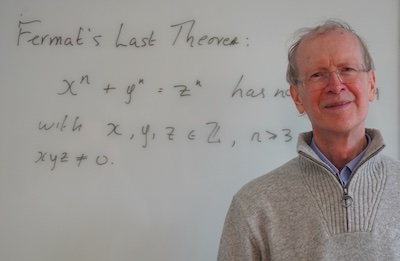
    Andrew Wiles, smiling, standing in front of the statement of Fermat's Last Theorem,  in May 2023 (Image courtesy of the INI)

    Andrew Wiles, at the University of Oxford in 2023 (Image courtesy of the INI)

    This is a special joint episode with the INI's Living Proof podcast, made in collaboration with our friend Dan Aspel, from the INI.

    You can find out more about Fermat's Last Theorem in the article that accompanies this podcast, and in this collection of further reading.

    Return to the advent calendar 2024!

    You can listen to the podcast using the player above, and you can listen and subscribe to our podcast through Apple Podcasts, Spotify and through most other podcast providers via podbean.


    This podcast was produced as part of our collaboration with the Isaac Newton Institute for Mathematical Sciences (INI) – you can find all the content from the collaboration here. 

    The INI is an international research centre and our neighbour here on the University of Cambridge's maths campus. It attracts leading mathematical scientists from all over the world, and is open to all. Visit www.newton.ac.uk to find out more.

    INI logo


    • Log in or register to post comments

    Our Podcast: Maths on the Move

    Our Maths on the Move podcast brings you the latest news from the world of maths, plus interviews and discussions with leading mathematicians and scientists about the maths that is changing our lives.

    Apple Podcasts
    Spotify
    Podbean

    Plus delivered to you

    Keep up to date with Plus by subscribing to our newsletter or following Plus on X or Bluesky.

    University of Cambridge logo

    Plus is part of the family of activities in the Millennium Mathematics Project.
    Copyright © 1997 - 2025. University of Cambridge. All rights reserved.

    Terms