News story

A five that fits
A brand-new pentagon to tile your wall with.

Marianne Freiberger is Editor of Plus. She joined Plus in 2005 after doing a PhD and then a three year postdoc at Queen Mary, University of London. As a researcher she worked in complex dynamics, the area of pure maths that has given us the Mandelbrot set. In the world of maths communication she has been Editor-in-Chief of the Mathscareers website, given presentations to mathematicians about how to communicate their work to a wider audience, and to journalists about how to deal with maths in the media. She has been a TEDx speaker and an invited speaker at the International Congress of Mathematicians in 2010.
Together with Rachel Thomas, Marianne has co-authored several popular maths books including Numericon: A journey through the hidden lives of numbers and Understanding numbers, and were editors on the book 50: visions of mathematics. They were Science Editors for the Discovery+ documentary series Universe Unravelled about the work of the Stephen Hawking Centre for Theoretical Cosmology.
In October 2022 Marianne and Rachel received a SPI-M-O Award for Modelling and Data Support (SAMDS) from the UK's Scientific Advisory Group for Emergencies. This award recognised their work with the JUNIPER modelling consortium to provide a wide audience (including public, press, policy makers and government) with clear and accessible explanations of some of the maths that was vital in responding to the COVID-19 pandemic.





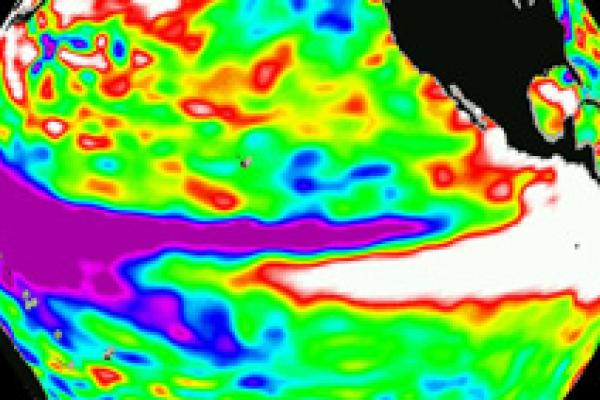
El Niño is a climate event without equal, causing droughts, floods, hurricanes and typhoons around the globe. How can we understand and predict it?