
Can you see the sound of a drum?
Brief summary
This article follows on from a previous article on geometric spectral theory, which investigates what vibrations associated to a (mathematical) object can tell you about the object itself.
In 1808 the musician and physicist Ernst Chladni visited the Academy of Sciences in Paris, a venerable organisation founded in 1666 by King Louis XIV. Its aim was, and still is, to promote French scientific research.
Chladni presented an experiment which still stuns audiences today. By running the bow of a violin over the edge of a metal plate, he got the plate to vibrate. A sparse layer of sand covering the plate responded by forming fascinating geometric patterns.
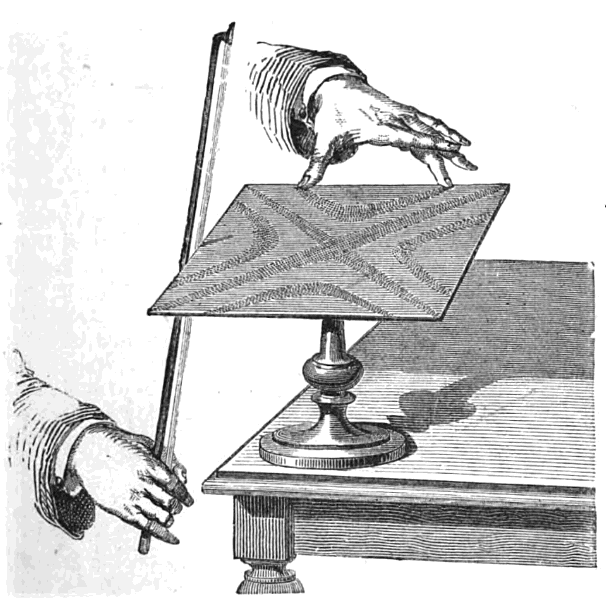
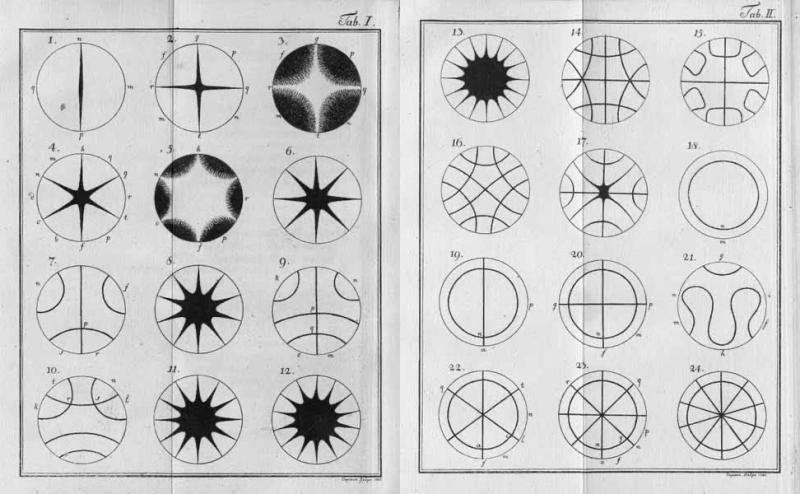
Here's a modern version of Chladni's experiment:
Attending the demonstration of the experiment was none other than Napoleon himself. Amazed, he offered a prize for the best mathematical description of the phenomenon.
Sophie Germain
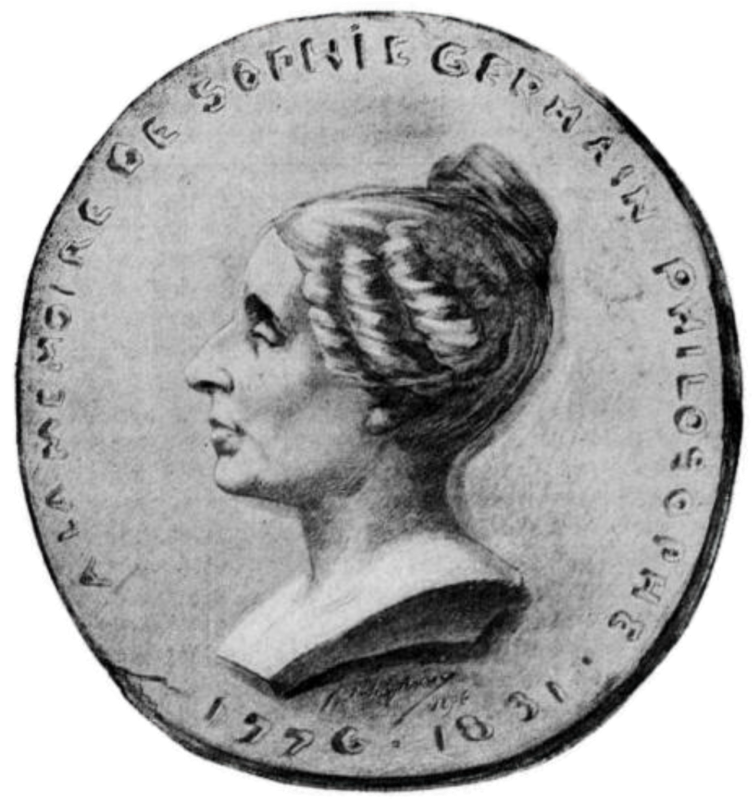
The challenge attracted one of the foremost mathematicians of the time. Sophie Germain had been born in Paris in 1776 (the 250th anniversary of her birth is being celebrated this year). The chaos that ensued after the storming of the Bastille in July 1789 confined the thirteen-year-old Sophie to her home and she decided to explore her father's library. Reading about Archimedes' passion for maths, she resolved that she, too, would become a mathematician.
But that was easier thought than done. Higher education wasn't open to women at the time, so Germain resorted to teaching herself, using notes from university courses that had found their way into her hands, and submitting work under a male pseudonym. Some leading mathematicians, notably Joseph-Louis Lagrange, recognised her talents, but many others dished out a treatment still often inflicted on those who don't fit in: they ignored her.
Despite these challenges Germain entered the competition inspired by Chladni's plates. Hers was the only entry — the problem was thought too hard for the time — and it did not win. It took two extensions of the competition, and two more entries by Germain, for her to win the prize of a medal made of one kilogram of gold in 1815. You can read more about Germain's life and work here.
Standing waves and nodal lines
Chladni's patterns can appear on any vibrating surface, including that of a drum. In a previous article we asked whether the sound of a drum can tell us anything about its shape. The question now is how Chladni patterns are related to the vibrations that produce sound. Hence the name of this article.
The physical explanation of the patterns is relatively easy to grasp. The bow of the violin causes the surface in question to vibrate. The vibration involves waves travelling across the plate and reflecting off its boundary to interfere with each other. This interference results in waves reinforcing each other in some places and cancelling each other out in others. What is left are combinations of standing waves: these are waves that don't travel across the plate but have points oscillating up and down.
With such a combination of standing waves there are places where the plate vibrates violently, but there are also places where the plate is completely still. And this explains the pattern: sand is bounced off areas where the vibration is strong and comes to rest in areas where the plate is still. The still areas happen to form lines, known as nodal lines. And these nodal lines create the pattern.
Germain's work provided the first breakthrough in the mathematical explanation of the phenomenon. It gave rise to the equation which governs the vibration of elastic surfaces. However, not every mathematical solution of the equation corresponds to a physical process. The ones that do need to satisfy certain boundary conditions, which reflect the constraints of the real physical world. And here's where Germain went wrong: the boundary conditions she identified weren't correct.
Governing equation for Chladni plates
The equation is $$\frac{\partial^2 u}{\partial t^2} + k^2 \Delta^2 u = 0.$$ Here $u(x,y,t)$ is the vertical displacement of the plate at any given coordinate $(x,y)$ and time $t$, $k$ is a constant representing the physical properties of the plate, factoring in its bending rigidity, thickness, and material density. $\Delta^2$ is the Laplacian operator applied twice. See here to find out more about the Laplacian.
The problem was fixed later on in the century by Gustav Kirchhoff and Augustus Love. Using Kirchhoff–Love plate theory you can exactly calculate the nodal lines for perfectly circular plates and a handful of other regular shapes under specific conditions. for perfectly circular, square, and rectangular plates and a handful of other regular shapes under specific conditions. The mathematics involves finding eigenfunctions values of the Laplacian operator we met in the previous article and in more detail in this explainer. (Technically you can calculate the nodal lines for any shape for which you can explicitly calculate a basis for the eigenfunctions.)
But what if the shape of the plate isn't so regular? And what if we ask the mathematical version of the question for higher-dimensional shapes?
These questions take us from the eighteenth century straight to the cutting edge of mathematical research. Earlier this year leading mathematicians from around the world got together at the Isaac Newton Institute for Mathematical Sciences to investigate mathematical questions of a similar nature. The programme was called Geometric spectral theory and applications — the word spectral here doesn't refer to ghosts, but to information that describes waves.
From Chladni plates to hot spots
One of the questions the programme investigated illustrates just how rich the area is. If you warm up one part of a metal sheet, the heat will dissipate until eventually an equilibrium is reached — the temperature is the same everywhere. Before this happens, though, there will always be a hottest spot and a coldest spot. These will travel across the plate as it strives towards equilibrium. Where do their trajectories lead them as that process approaches its end (technically, what is their asymptotic behaviour)?
Answering the question involves the heat equation, which is shown in the box. The equation looks quite different from Germain's equation for vibrating metal plates. But if you look at Chladni patterns, not on a rigid plate, but on a membrane such as the skin of a drum, the equation simplifies. You are now dealing with a wave equation (about which you can find out more here) that looks a little more similar to the heat equation (see the box).
The heat equation
The heat equation is:
$$\frac{\partial u}{\partial t} = \alpha \Delta u.$$
Here $\Delta$ is the Laplacian operator and $u(x,y,t)$ the temperature at point $(x,y)$ and time $t$. The constant $\alpha$ captures how well the material allows heat to flow.
The wave equation
The wave equation is:
$$\frac{ \partial^2 u}{d t^2} = c^2 \Delta u,$$
Where the constant captures physical properties of the membrane and can also be understood as the wave speed. Find out more here.
Both equations involve the Laplacian and there's a reason for that. Applied to a function at a particular point in space, the Laplacian tells you how much the value of the function at that point differs from the average value taken over an infinitesimal neighbourhood of that point.
On a vibrating membrane this matters because the bigger this difference, the more prominently the surface bulges at the point. And the more it bulges, the stronger the restoring force that draws the point back to equilibrium. As far as heat is concerned, the difference from the average matters because heat flows from one region to another when there is a temperature difference (to be precise, it flows from hot to cold).
As a result, the maths involved in Chladni membranes is very similar to that involved in heat flow.
Living on the edge
So what is the answer to the question regarding hot and cold spots? In 1974 the mathematician Jeffrey Rauch conjectured that it lies at the edges. As a heated plate reaches equilibrium temperature the hottest and coldest spots head for the edge of the plate — at least as long as the shape of the plate isn't too awkward. (To be precise, Rauch formulated a mathematical statement which captures this physical picture.)
But a conjecture is nothing but a hypothesis: to be absolutely sure, you need mathematical proof. Finding such a proof for the hotspots conjecture has turned into a decades-long project that still isn't finished. Indeed, it has turned out that for some shapes of plate, the hotspot conjecture is actually false: the last remaining heat remains trapped deep in the interior.
Proving the hotspot conjecture for more shapes — possibly higher-dimensional and with unusual geometries — has been a major focus of the INI programme and important progress has been made during its duration.
The mathematical insight gained is useful in a range of applications which can seem quite unrelated at first sight. An example involves the study of networks: structures made up of nodes connected by links which could represent social, transport, biological and all sorts of other connections. The mathematics of the hot spot conjecture can help us understand a complex theoretical network in terms of tightly connected clusters that might exist inside it.
But for most of the mathematicians involved, thinking about things like the hotspot conjecture is a purely mathematical pursuit, which has connections to a surprising number of other fields in maths. The fact that eigenvalues of the Laplacian can be extremely hard to calculate (see the previous article) provides a link to the field of numerical analysis which is all about approximating solutions to equations when no formulas are known. There is also a link to number theory because some of the equations that need to be solved also turn up in the study of integers and equations made up from integers.
The fact that waves reflect off the boundaries of the shapes in question links up to the field of mathematical billiards, which studies the possible behaviour of an idealised billiard ball moving around on an idealised (and potentially awkwardly-shaped) billiard table. And the fact that we are dealing with membranes stretched over frames means that there's a connection to the area of maths that investigates minimal surfaces such as those you get when you dip a plastic frame into soapy liquid in order to blow bubbles.
It's interesting to see just how far a single mathematical question can take you. As the organisers of the INI programme put it:
"In his celebrated paper Can One Hear the Shape of a Drum?, Mark Kac proposed to see 'how much about the shape can be inferred from the knowledge of all the eigenvalues, and to impress upon you the multitude of connections between our problem and various parts of mathematics and physics.' Sixty years later, we hope this programme has shown how far those connections now reach."
About this article
Marianne Freiberger is Editor of Plus. She would like to thank Asma Hassannezhad and Michael Levitin for their help with this article. Both were co-organisers of the INI research programme Geometric spectral theory and applications.
This content forms part of our collaboration with the Isaac Newton Institute for Mathematical Sciences (INI) – you can find all the content from the collaboration here.
The INI is an international research centre and our neighbour here on the University of Cambridge's maths campus. It attracts leading mathematical scientists from all over the world, and is open to all. Visit www.newton.ac.uk to find out more.
