

Can you hear the shape of a drum?
Brief Summary
This article explores some aspects of geometric spectral theory, which investigates whether information about vibrations associated with a (mathematical) object can tell you something about the object itself.
Earlier this year leading mathematicians from around the world got together at the Isaac Newton Institute for Mathematical Sciences to investigate a question at the cutting end of research: Can you hear the shape of a drum?
That's no joke, though admittedly the question is a proxy for a wider area of research, which investigates whether information about vibrations associated with a (mathematical) object can tell you something about the object itself. Results are useful in a wide range of areas, from structural engineering to medical imaging, and involve some very rich mathematics.
The sound of a string
If you play a stringed instrument you will know that the length of a string determines the pitch of the sound you hear. This is why pressing a guitar string at different frets changes the sound the string makes: the further in you go on the guitar's neck, the higher the pitch.
All this is down to vibrations. When you pluck a guitar string, the string vibrates at a certain fundamental frequency. The vibration sets in motion minute pockets of higher and lower air pressure which eventually hit your ear. The higher the frequency at which the air pockets strike your ear, the higher the pitch of the sound you hear.
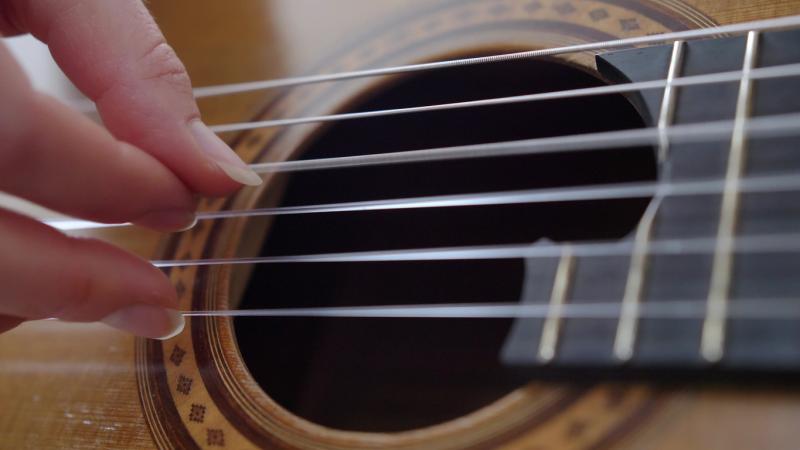
Back in 1636 priest and polymath Marin Mersenne (who also has a type of prime number named after him) published Harmonie universelle, a momentous work designed to summarise all musical knowledge of the day. In it, there is an equation, now known as Mersenne's law, which tells you how to work out a string's fundamental frequency (see the box).
The formula confirms that the longer the string, the lower the frequency. In this sense, you can hear the length of a piece of string.
Mersenne's law
Mersenne's law states that the fundamental frequency $f$ of a plucked string is:
$$f=\frac{1}{2L} \sqrt{\frac{T}{m}}.$$
Here $L$ is the length of the string, $T$ is the tension, and $m$ is the mass of the string per unit length. For the example of a single string on a guitar, $T$ and $m$ are fixed so the frequency, and therefore pitch, only depend on the fret you press on.
We should also mention that when a string is vibrating at the fundamental frequency, it is also vibrating at harmonic frequencies which are exact multiples of the fundamental frequency. See this article to find out more.
The harmonic frequencies don't influence the pitch. But different instruments produce these harmonics at different volumes compared to the fundamental frequency. This explains why a note played on a guitar sounds different from the same note played on a violin.
The frequencies will all be the same, but each instrument combines them uniquely. (Find out more in Maths in a minute: Maths and music and The magical mathematics of music.)
The sound of a drum
A drum is made up of a membrane stretched over a frame. Again the pitch we hear when someone bangs the drum depends on the fundamental frequency of the drumhead (the membrane stretched over the frame). Can we deduce something about the shape of the drumhead from the pitch?

In theory it's possible to work out the fundamental frequency mathematically. In doing this, you imagine the shape of the drumhead as a region in the two-dimensional plane. The fundamental frequency is determined by a number technically known as the first Dirichilet eigenvalue of the Laplacian operator associated with the shape of the region. The eigenvalue is usually denoted by the Greek letter $\lambda$. If you want to brave some calculus you can find out more in this article.
The question of whether we can hear the shape of a drum can be turned into a purely mathematical problem. What can the parameter $\lambda$ tell us about the geometric shape of the drumhead?
We can go a little further. There is actually a whole hierarchy of parameters associated with the Laplacian. Our $\lambda$ above is the first in this hierarchy while the others determine higher harmonic frequencies. What can knowing the entire hierarchy tell us about the shape? (Technically all these parameters are all Dirichilet eigenvalues of the Laplacian.)
At first sight, things look promising. In 1911 the mathematician Hermann Weyl proved a result which shows that, once you know all the Dirichilet eigenvalues of the shape of the drumhead (when you view the shape as domain in the plane encompassed by a boundary), then you can calculate the exact area of the drumhead. The result is now known as Weyl's law. It inspired the physicist Mark Kac’s to ask the question in the title of this article, back in 1966: can you hear the shape of a drum?
A huge amount of mathematical time and effort went into attempts to answer the question. It wasn't until 1980, nearly 70 years after Weyl's result, that mathematicians finally knew that you could also calculate the length of the perimeter of the drumhead's shape, as well as the number of holes it might have, from the Dirichilet eigenvalues. Central to all this was work by Henry McKean and Isadore Singer (number of holes) and Åke Pleijel, Subbaramiah Minakshisundaram and Victor Ivrii (perimeter).
So since the eigenvalues give you the fundamental and harmonic frequencies you can, in the metaphorical sense, "hear" the area and the perimeter of a drumhead, as well as the number of holes.
This looks promising, until you realise that two very different shapes can have the same area, the same length of perimeter, and the same number of holes. Can the Dirichilet eigenvalues help you distinguish between two such shapes?
The answer arrived in a breakthrough paper published in 1992 by Carolyn Gordon, David L. Webb and Scott Wolpert. It's no. Gordon, Webb and Wolpert came up with two different shapes that give rise to the same sequence of Dirichilet eigenvalues:
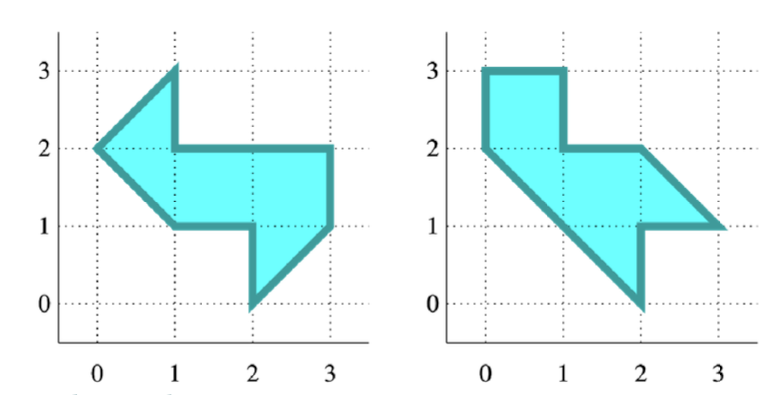
Two drumheads that have these shapes and are made from the same material stretched over a frame with identical tension would therefore come with the same fundamental frequency and harmonics. Simply listening to their sound, or analysing the frequencies, would not allow you to tell them apart.
Gordon, Webb and Wolpert's result was by no means the last word in the field. In fact, Carolyn Gordon was a Distinguished Kirk Fellow at the Newton Institute for the research programme mentioned at the start of this article. The programme was called Geometric spectral theory and applications — the word spectral refers to information about waves, such as frequencies and wavelengths.
Another question that's closely related to the INI programme is whether you can "see" the sound of a drum. Find out more in the next article.
About this article
Marianne Freiberger is Editor of Plus. She would like to thank Asma Hassannezhad and Michael Levitin for their help with this article. Both were co-organisers of the INI research programme Geometric spectral theory and applications.
This content forms part of our collaboration with the Isaac Newton Institute for Mathematical Sciences (INI) – you can find all the content from the collaboration here.
The INI is an international research centre and our neighbour here on the University of Cambridge's maths campus. It attracts leading mathematical scientists from all over the world, and is open to all. Visit www.newton.ac.uk to find out more.
