
Home
plus.maths.org

Secondary menu

  • My list
  • About Plus
  • Sponsors
  • Subscribe
  • Contact Us
  • Log in
  • Main navigation

  • Home
  • Articles
  • Collections
  • Podcasts
  • Maths in a minute
  • Puzzles
  • Videos
  • Topics and tags
  • For

    • cat icon
      Curiosity
    • newspaper icon
      Media
    • graduation icon
      Education
    • briefcase icon
      Policy

    Popular topics and tags

    Shapes

    • Geometry
    • Vectors and matrices
    • Topology
    • Networks and graph theory
    • Fractals

    Numbers

    • Number theory
    • Arithmetic
    • Prime numbers
    • Fermat's last theorem
    • Cryptography

    Computing and information

    • Quantum computing
    • Complexity
    • Information theory
    • Artificial intelligence and machine learning
    • Algorithm

    Data and probability

    • Statistics
    • Probability and uncertainty
    • Randomness

    Abstract structures

    • Symmetry
    • Algebra and group theory
    • Vectors and matrices

    Physics

    • Fluid dynamics
    • Quantum physics
    • General relativity, gravity and black holes
    • Entropy and thermodynamics
    • String theory and quantum gravity

    Arts, humanities and sport

    • History and philosophy of mathematics
    • Art and Music
    • Language
    • Sport

    Logic, proof and strategy

    • Logic
    • Proof
    • Game theory

    Calculus and analysis

    • Differential equations
    • Calculus

    Towards applications

    • Mathematical modelling
    • Dynamical systems and Chaos

    Applications

    • Medicine and health
    • Epidemiology
    • Biology
    • Economics and finance
    • Engineering and architecture
    • Weather forecasting
    • Climate change

    Understanding of mathematics

    • Public understanding of mathematics
    • Education

    Get your maths quickly

    • Maths in a minute

    Main menu

  • Home
  • Articles
  • Collections
  • Podcasts
  • Maths in a minute
  • Puzzles
  • Videos
  • Topics and tags
  • Audiences

    • cat icon
      Curiosity
    • newspaper icon
      Media
    • graduation icon
      Education
    • briefcase icon
      Policy

    Secondary menu

  • My list
  • About Plus
  • Sponsors
  • Subscribe
  • Contact Us
  • Log in
  • Adventures in Model Land

    4 November, 2025

    You are blue, and are surrounded by other blue people: swirling together in a dot, identical and indistinguishable. From somewhere above you hear the ticking of a clock, and suddenly find yourself and some of your fellows pulled upwards, sucked through a tube arcing high above...

    Intrigued? That is a description of one of Jess Enright's adventures in her mathematical models. This is an exciting new approach that researchers are using to invite people into the worlds of their models, both to communicate their research to the people outside of academia, but also for the researchers themselves to reflect on what aspects of reality these models actually do, and don't, describe.

    These adventures in model land build on the work of Erica Thompson in her book, Escape from Model Land: how mathematical models can lead us astray and what we can do about it. Any mathematical description of a process in the world around us is a mathematical model: whether it's describing the processes in our climate, the spread of a disease through a population or the movement of water across a landscape. They are incredibly useful and key to research in modern mathematics and science. But these mathematical models are, by necessity, simplifications of the real world.

    Erica's book inspired geoscientist Chris Skinner to use principles of role-playing games to explore and communicate mathematical models. And this approach was a perfect fit with Jess' experience building board games to communicate her research - we event get to play some in this podcast at the huge UK Games Expo in Birmingham earlier this year!
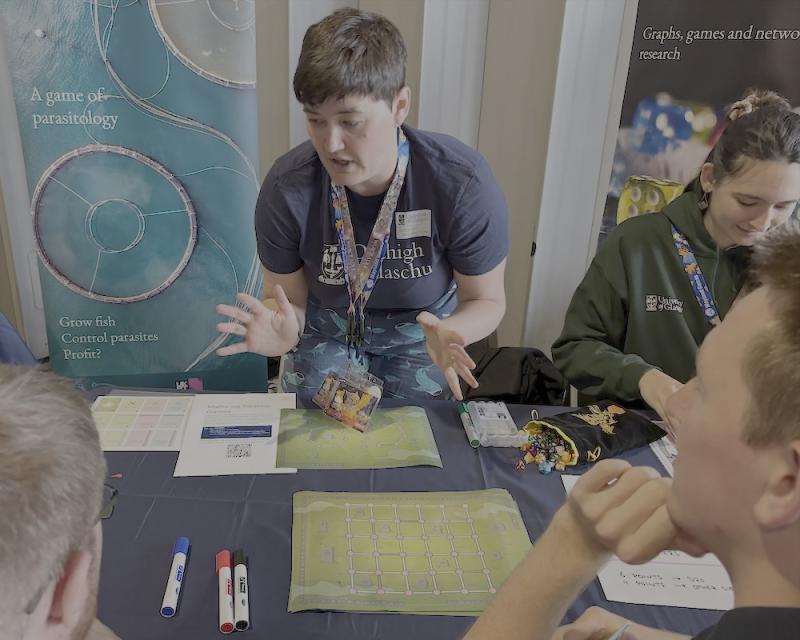
    Jess Enright, along with Emma Gort, in action at the UK Games Expo in Birmingham earlier in 2025 showing their board games exploring mathematical models to interested players. (Photo: Rachel Thomas)
    Jess Enright, along with Emma Gort Tarrus, in action at the UK Games Expo in Birmingham earlier in 2025. (Photo: Rachel Thomas)

    In this podcast we talk to Jess (a reader in the school of Computing Science at the University of Glasgow and member of the JUNIPER partnership of disease modellers from across the UK), Chris (an independent geoscientist and researcher and a visiting fellow at York St John University)and Erica (Associate Professor of Modelling for Decision Making at University College, London) about their explorations of these ideas.

    You can find out more information about the ideas discussed in the podcast here:

    • Maths in a Minute: Mathematical model – a brief and an accessible introduction to mathematical models and where they are used.
    • Escape from Model Land: how mathematical models can lead us astray and what we can do about it – Erica's book
    • Adventures in Model Land– the framework, developed by Chris, Erica and Jess, together with Liz Lewis, Rolf Hut and Sam Illingworth, for exploring mathematical models using table-top role-play games
    • You can find some of the adventures in model land and other games that Jess took to the UK Games Expo in Birmingham

    This podcast is part of our collaboration with JUNIPER, the Joint UNIversity Pandemic and Epidemic Response modelling consortium. JUNIPER comprises academics from the universities of Cambridge, Warwick, Bristol, Exeter, Oxford, Manchester, and Lancaster, who are using a range of mathematical and statistical techniques to address pressing questions about the control of COVID-19. You can see more content produced with JUNIPER here.

    Juniper logo
    • Log in or register to post comments
    You can listen to the podcast using the player above, and you can listen and subscribe to our podcast through Apple Podcasts, Spotify and through most other podcast providers via podbean.

    You might also like

    article

    Maths in a minute: Mathematical models

    A basic introduction to the most powerful tools in science and engineering.
    article

    Tracing mpox

    What do we know about mpox, what do we not know, and what efforts are going into modelling it?

    article

    Climate modelling made easy

    Make your own climate prediction with this simple, but powerful, model!

    Read more about...

    Juniper
    mathematical modelling
    epidemiology
    University of Cambridge logo

    Plus is part of the family of activities in the Millennium Mathematics Project.
    Copyright © 1997 - 2025. University of Cambridge. All rights reserved.

    Terms