
News story
Article

Cars in the next lane really do go faster
Yes, you were right to wish you were in the other lane during this morning's commute! Nick Bostrom tells why we're usually caught in the slow lane.
Article
Maths on the tube
During World Mathematical Year 2000 a sequence of posters were displayed month by month in the trains of the London Underground aiming to stimulate, fascinate - even infuriate passengers! Keith Moffatt tells us about three of the posters from the series.
Article

Measure for measure
Can you imagine objects that you can't measure? Not ones that don't exist, but real things that have no length or area or volume? It might sound weird, but they're out there. Andrew Davies gives us an introduction to Measure Theory.
Article
Model Trains
As customers will tell you, overcrowding is a problem on trains. Fortunately, mathematical modelling techniques can help to analyse the changing demands on services through the day. Tim Gent explains.
Article

Friends and strangers
Sometimes a mathematical object can be so big that, however disorderly we make the object, areas of order are bound to emerge. Imre Leader looks at the colourful world of Ramsey Theory.
Article

On the dissecting table
Bill Casselman writes about the intriguing amateur mathematician Henry Perigal, who took his elegant proof of Pythagoras' Theorem literally to his grave - by having it carved on his tombstone.
Article
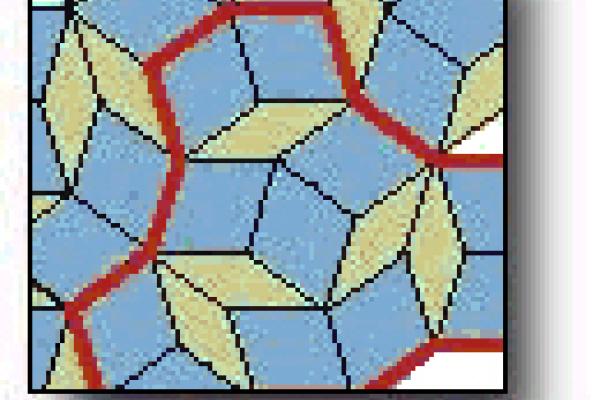
From quasicrystals to Kleenex
This pattern with kite-shaped tiles can be extended to cover any area, but however big we make it, the pattern never repeats itself. Alison Boyle investigates aperiodic tilings, which have had unexpected applications in describing new crystal structures.
Article

Rogue trading?
The dangers of trading derivatives have been well-known ever since they were catapulted into the public eye by the spectacular losses of Nick Leeson and Barings Bank. John Dickson explains what derivatives are, and how they can be both risky, and used to reduce risk.
Article
Mathematical mysteries: The Solitaire Advance
Solitaire is a game played with pegs in a rectangular grid. A peg may jump horizontally or vertically, but not diagonally, over a peg in an adjacent square into a vacant square immediately beyond. The peg which was jumped over is then removed.
News story
Faster than light
Scientists at the NEC Research Institute in Princeton have carried out an experiment in which a pulse of light appeared to emerge from a cloud of gas before it even entered.
Article

Emmy Noether: Against the odds
A brief look at Emmy Noether's challenging journey to become one of the twentieth century's great mathematicians.