

Home
plus.maths.org

Secondary menu

  • My list
  • About Plus
  • Sponsors
  • Subscribe
  • Contact Us
  • Log in
  • Main navigation

  • Home
  • Articles
  • Collections
  • Podcasts
  • Maths in a minute
  • Puzzles
  • Videos
  • Topics and tags
  • For

    • cat icon
      Curiosity
    • newspaper icon
      Media
    • graduation icon
      Education
    • briefcase icon
      Policy

    Popular topics and tags

    Shapes

    • Geometry
    • Vectors and matrices
    • Topology
    • Networks and graph theory
    • Fractals

    Numbers

    • Number theory
    • Arithmetic
    • Prime numbers
    • Fermat's last theorem
    • Cryptography

    Computing and information

    • Quantum computing
    • Complexity
    • Information theory
    • Artificial intelligence and machine learning
    • Algorithm

    Data and probability

    • Statistics
    • Probability and uncertainty
    • Randomness

    Abstract structures

    • Symmetry
    • Algebra and group theory
    • Vectors and matrices

    Physics

    • Fluid dynamics
    • Quantum physics
    • General relativity, gravity and black holes
    • Entropy and thermodynamics
    • String theory and quantum gravity

    Arts, humanities and sport

    • History and philosophy of mathematics
    • Art and Music
    • Language
    • Sport

    Logic, proof and strategy

    • Logic
    • Proof
    • Game theory

    Calculus and analysis

    • Differential equations
    • Calculus

    Towards applications

    • Mathematical modelling
    • Dynamical systems and Chaos

    Applications

    • Medicine and health
    • Epidemiology
    • Biology
    • Economics and finance
    • Engineering and architecture
    • Weather forecasting
    • Climate change

    Understanding of mathematics

    • Public understanding of mathematics
    • Education

    Get your maths quickly

    • Maths in a minute

    Main menu

  • Home
  • Articles
  • Collections
  • Podcasts
  • Maths in a minute
  • Puzzles
  • Videos
  • Topics and tags
  • Audiences

    • cat icon
      Curiosity
    • newspaper icon
      Media
    • graduation icon
      Education
    • briefcase icon
      Policy

    Secondary menu

  • My list
  • About Plus
  • Sponsors
  • Subscribe
  • Contact Us
  • Log in
  • Maths in a minute: the Fibonacci sequence

    1 May, 2020
    3 comments
    Leonardo Fibonacci c1175-1250.

    Leonardo Fibonacci c1175-1250.

    The Fibonacci sequence

    $$1, 1, 2, 3, 5, 8, 13, 21, 34, 55, 89, ...$$ is one of the most famous number sequences of them all. We've given you the first few numbers here, but what's the next one in line? It turns out that the answer is simple. Every number in the Fibonacci sequence (starting from $2$) is the sum of the two numbers preceding it: \begin{eqnarray*} 2 & = & 1 &+& 1 \\ 3 & = & 1 &+& 2 \\ 5 & = & 2 &+& 3\\ 8 & = & 3 &+& 5, \end{eqnarray*} and so on. So it's pretty easy to figure out that the next number in the sequence above is $55+89 = 144,$ and (in theory at least) to work out all numbers that follow from here to infinity.

    Hear the music of the Fibonacci sequence in our podcast!

    Where does it come from?

    The Fibonacci is named after the mathematician Leonardo Fibonacci who stumbled across it in the 12th century while contemplating a curious problem. Fibonacci started with a pair of fictional and slightly unbelievable baby rabbits, a baby boy rabbit and a baby girl rabbit.

    rabbits

    They were fully grown after one month

    rabbits

    and did what rabbits do best, so that the next month two more baby rabbits (again a boy and a girl) were born.

    rabbits

    The next month these babies were fully grown and the first pair had two more baby rabbits (again, handily a boy and a girl).
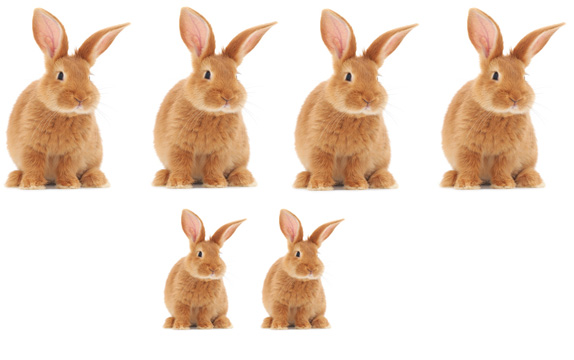
    rabbits

    Ignoring problems of in-breeding, the next month the two adult pairs each have a pair of baby rabbits and the babies from last month mature.

    rabbits
    Fibonacci asked how many rabbits a single pair can produce after a year with this highly unbelievable breeding process (rabbits never die, every month each adult pair produces a mixed pair of baby rabbits who mature the next month). He realised that the number of adult pairs in a given month is the total number of rabbits (both adults and babies) in the previous month. Writing $A_n$ for the number of adult pairs in the $nth$ month and $R_n$ for the total number of pairs in the $nth$ month, this gives $$A_n = R_{n-1}.$$ Fibonacci also realised that the number of baby pairs in a given month is the number of adult pairs in the previous month. Writing $B_n$ for the number of baby pairs in the $nth$ month, this gives $$B_n = A_{n-1} = R_{n-2}.$$ Therefore, the total number of pairs of rabbits (adult+baby) in a particular month is the sum of the total pairs of rabbits in the previous two months: $$R_n = A_n + B_n = R_{n-1}+R_{n-2}.$$ Starting with one pair, the sequence we generate is exactly the sequence at the start of this article. And from that we can see that after twelve months there will be $144$ pairs of rabbits.

    Where does it go?

    Real rabbits don't breed as Fibonacci hypothesised, but his sequence still appears frequently in nature, as it seems to capture some aspect of growth. You can find it, for example, in the turns of natural spirals, in plants, and in the family tree of bees. The sequence is also closely related to a famous number called the golden ratio. To find out more visit our collection of articles about Fibonacci and his mathematics. And if you'd like to hear how the Fibonacci sequence sounds you should listen to our podcast!


    About the author

    Rachel Thomas is Editor of Plus.

    • Log in or register to post comments

    Comments

    jennifer yusi

    17 July 2020

    Permalink

    The rabit as a cover of this page, which attracts me to open the post. The number of rabbit is a good way to apply in mathmatics. That's funny!

    • Log in or register to post comments

    Steve

    31 July 2020

    Permalink

    If you start with 0 and 1 then every number after those is the sum of the two numbers preceding it.

    • Log in or register to post comments

    Shariputra

    22 September 2020

    Permalink

    The Fibonacci sequence was actually discovered much earlier by Indian poets and linguists who came across this sequence while studying Sanskrit poetry. More information on this can be found, for example, on the wikipedia page for the Fibonacci numbers: https://en.wikipedia.org/wiki/Fibonacci_number. This topic is also discussed by the Fields Medallist Manjul Bhargava in multiple lectures on YouTube.

    Hence, in this article, under the heading 'Where does it come from'?, it might be pertinent to mention that this sequence was in fact discovered much earlier. This might help dispel the misunderstanding that Fibonacci was the first one to come across this sequence. It will also enrich the article by showing the readers how this sequence arose from a completely different (and surprising!) context- poetry!

    • Log in or register to post comments

    Read more about...

    Maths in a minute
    Fibonacci
    Fibonacci number

    Our Podcast: Maths on the Move

    Our Maths on the Move podcast brings you the latest news from the world of maths, plus interviews and discussions with leading mathematicians and scientists about the maths that is changing our lives.

    Apple Podcasts
    Spotify
    Podbean

    Plus delivered to you

    Keep up to date with Plus by subscribing to our newsletter or following Plus on X or Bluesky.

    University of Cambridge logo

    Plus is part of the family of activities in the Millennium Mathematics Project.
    Copyright © 1997 - 2025. University of Cambridge. All rights reserved.

    Terms