

A very old problem turns 20
"I think I'll stop here." This is how, on 23rd of June 1993, Andrew Wiles ended his series of lectures at the Isaac Newton Institute in Cambridge. The applause, so witnesses report, was thunderous: Wiles had just delivered a proof of a result that had haunted mathematicians for over 350 years: Fermat's last theorem.
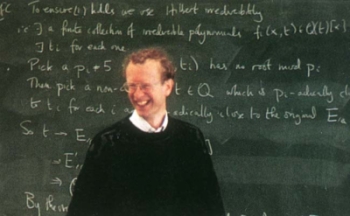
Andrew Wiles.
When Wiles announced his proof at the Newton Institute he had spent seven years working on the problem in secret, avoiding the attention he would have attracted had he admitted to what he was doing. In fact he had been working on a more general problem, called the Taniyama-Shimura conjecture, whose solution implied Fermat's last theorem, but which was considered pretty inaccessible by most mathematicians at the time. "But Although Wiles hadn't published anything on this topic, everyone knew if anyone was to prove Fermat's last theorem, he had a good chance," recalls Tom Körner, a mathematician at the University of Cambridge. "I had interviewed Wiles for a fellowship at Trinity Hall, Cambridge, just before he moved to Princeton. Everyone said he was brilliant."
Before Wiles announced his proof he had already lectured for two days, as part of a research programme at the Newton Institute. "Rumours were flying around that something important would happen on the third day," says Körner. "I asked his student what was happening and he said 'I can't tell you'. I asked him 'Will I regret not being there on the last day?' and he said 'Yes'."
Wiles' lecture lived up to expectations: "The atmosphere was electric," says Körner. "After he finished, there was a storm of applause and then the few people in the audience who knew the material asked questions, and then said the result looked good."
And it is not all about the bottom line. "Wiles' proof has had a greater impact than that of other results, like the four colour theorem, because of the mathematics that was created to prove the theorem," says Körner. As it turned out, Wiles' proof did contain a flaw which took another year and help from a former student, Richard Taylor, to fix. But in the end the 357-year-old-problem yielded to the sophisticated techniques developed to crack it.
Further reading
You can find out more about Andrew Wiles and Fermat's last theorem in these Plus articles:
Comments
Anonymous
I have to say I find Wiles' work brilliant but unsatisfying. I want to know what Fermat's proof was - it sure didn't involve the Taniyama-Shimura conjecture!
Anonymous
Fermat didn't have a proof, he only thought he did.
Anonymous
After writing the comment, Fermat published a proof of a special case of the theorem. He realized that his general proof didn't work. So there was no marvelous proof, after all.
mathagnostic
Sorry to say but you are wrong. 5^2 - 3^2 = 4^2 is also 5^2 - 3^2 = 2^4 that is every x^n can be easily described by the equation z^2 - y^2 = x^n. (Actually every integer is described by this equation for z-y=1). This is an EQUALITY. So pray tell me how one can change the difference of two squared terms to the difference of two terms raised to the same power as x^n. This was Fermat's insight which I'm sure a man of his mathematical ability turned into a proof. The unfounded ignorance that abounds on this topic astounds me!
Anonymous
There's always more than one way to skin a cat!
Anonymous
We just don't know whether there exists a 'short cut' proof (or, as it is sometimes called, a proof 'from the book') at all that only uses 17th century maths solving this question. As Andrew Wiles said himself, his proof was surely 20th century, so Fermat would not have had that proof. But maybe Fermat had a proof of his own, or maybe Fermat was wrong in thinking he had a proof. What is known, is that he left behind some dazzling examples of factorization that are hard to explain with 17th century tools, so he surely had capabilities...it makes the thought he just might have had a short proof even more tantalizing.
Interesting even more is that this question on whether shorter proofs always exist (like the transcendence of pi by Hilbert, or the Prime Number Theorem by Erdos) look a lot like the P vs NP question, on whether problems that we now only can easily verify the answer of, are actually all easy problems, had mankind just been smart enough to just see these easy solutions! Maybe Wiles' proof of Fermat is as short as it gets, and if so, Fermat must have been wrong.
Anonymous
Has anybody tried to prove:
a³+b³+c³=d³
and for exponent n=4 you need 4 summands ...
mathagnostic
As you appear to be unaware of the fact, there are infinitely, infinitely many cubic quadruples
the smallest of which is 6^3 = 5^3 + 4^3 + 3^3 for the positive series and 9^3 = 8^3 + 6^3 - 1^3
for the negative series.
There are infinitely many quartic quadruples.
An 'interesting' trio of quadruples is:
[1] 159^4 = 158^4 + 59^4 + 1952^2
[2] 159^4 = 134^4 + 133^4 + 1952^2
[3] 158^4 = 134^4 + 133^4 - 59^4
If a Fermat triple existed it would mean that a trio of quadruples, 2 positive
and 1 negative and of the same power would also exist but the structure
of their interrelationship would be marginally different.
The 3 quadruples reduce to 3 Pythagorean quadruples.
Anonymous
I think you might have been referring to this: https://en.m.wikipedia.org/wiki/Euler%27s_sum_of_powers_conjecture . As you can see, it was once conjectured to be the case by Leonhard Euler that you would need 2 squares to add up to a square, 3 cubes to add up to a cube, four 4th powers to add up to a 4th power, etc. In 1966, however, a computer search revealed a counterexample: namely, there are four distinct (positive) integers whose fifth powers sum up to a fifth power.
Anonymous
Nice to see this written for the anniversary of Mr. Wiles' accomplishment. I recently finished Simon Singh's book on the same topic, and also watched the British documentary produced by Mr. Singh. Fascinating story!
Anonymous
Fermat's "proof" was surely wrong.
Anonymous
Please can I ask what are the grounds for the comment you have made?
Michael Paul Goldenberg
Plausibility: greater mathematicians than Fermat worked on this and couldn't prove it. If a 17th-century proof (so to speak) were feasible, surely Euler or Gauss - to name but two later mathematical geniuses of the highest rank - would have found it. It took 350 years or so to crack because we needed a lot of tools not available to Fermat or his successors. Many of them contributed to what culminated with Wiles/Taylor. That's not an irrefutable argument, but short of finding missing notes from Fermat, it's likely the best you'll get.