
Home
plus.maths.org

Secondary menu

  • My list
  • About Plus
  • Sponsors
  • Subscribe
  • Contact Us
  • Log in
  • Main navigation

  • Home
  • Articles
  • Collections
  • Podcasts
  • Maths in a minute
  • Puzzles
  • Videos
  • Topics and tags
  • For

    • cat icon
      Curiosity
    • newspaper icon
      Media
    • graduation icon
      Education
    • briefcase icon
      Policy

    Popular topics and tags

    Shapes

    • Geometry
    • Vectors and matrices
    • Topology
    • Networks and graph theory
    • Fractals

    Numbers

    • Number theory
    • Arithmetic
    • Prime numbers
    • Fermat's last theorem
    • Cryptography

    Computing and information

    • Quantum computing
    • Complexity
    • Information theory
    • Artificial intelligence and machine learning
    • Algorithm

    Data and probability

    • Statistics
    • Probability and uncertainty
    • Randomness

    Abstract structures

    • Symmetry
    • Algebra and group theory
    • Vectors and matrices

    Physics

    • Fluid dynamics
    • Quantum physics
    • General relativity, gravity and black holes
    • Entropy and thermodynamics
    • String theory and quantum gravity

    Arts, humanities and sport

    • History and philosophy of mathematics
    • Art and Music
    • Language
    • Sport

    Logic, proof and strategy

    • Logic
    • Proof
    • Game theory

    Calculus and analysis

    • Differential equations
    • Calculus

    Towards applications

    • Mathematical modelling
    • Dynamical systems and Chaos

    Applications

    • Medicine and health
    • Epidemiology
    • Biology
    • Economics and finance
    • Engineering and architecture
    • Weather forecasting
    • Climate change

    Understanding of mathematics

    • Public understanding of mathematics
    • Education

    Get your maths quickly

    • Maths in a minute

    Main menu

  • Home
  • Articles
  • Collections
  • Podcasts
  • Maths in a minute
  • Puzzles
  • Videos
  • Topics and tags
  • Audiences

    • cat icon
      Curiosity
    • newspaper icon
      Media
    • graduation icon
      Education
    • briefcase icon
      Policy

    Secondary menu

  • My list
  • About Plus
  • Sponsors
  • Subscribe
  • Contact Us
  • Log in
  • Magic 19: Solution

    5 September, 2016

    Here are 19 dots arranged in a hexagon. Your task is to label the dots with the numbers 1 to 19 so that each set of three dots that lie along a straight-line segment add up to 22.

    Happy puzzling!

    (Download the grid to print and scribble on.)

    Magic 19

    Solution

    Here's one solutions. If you have found others, or a good strategy for solving the puzzle, please let us know!

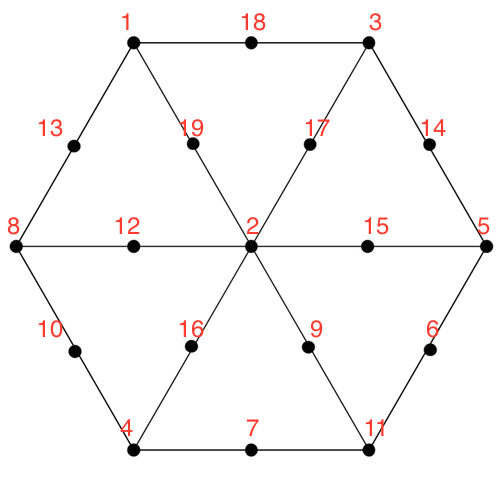
    Magic 19

    Magic 19

    Back to main puzzle page

    • Log in or register to post comments

    Anonymous

    27 September 2016

    Permalink
    Comment

    If x is the central dot, y1 to y6 the dots participating in 3 lines, z1 to z12 the dots only participating in one line, and if A=y1+y2+y3+y4+y5+y6 and B=z1+z2+...+z12, then:

    x+A+B=190 (the sum of all natural numbers from 1 to 19)
    6x+3A+B=264 (the sum of all 12 lines with a sum of 22)

    Therefore:
    A=(74-5x)/2 (1)
    B=(306+3x)/2 (2)
    With x,A,B being natural numbers

    Applying to x its possible values, i.e. 1,2,3,...,19 we have:
    For x=1, A= 34,5 --> so x isn't 1
    All odd values for x give the same result

    For x=2, A=32 and B=168. We accept x=2, because in this case A has a minimum value of A=1+3+4+5+6+7=26

    Same goes for x=4, since A=27 and B=159, with Amin=24

    For x=6, A=22 and B=162, with Amin=22; x=6 is the last acceptable value for x, since:
    for x=8, even though A and B are natural numbers, and therefore acceptable values, A < Amin and therefore x>8 is not an acceptable solution. Moreover, x has been shown to be an even number.

    However, if x=6, one cannot find any solution when trying to solve the grid. Therefore, solutions are acceptable only if x=2 or x=4.

    • Log in or register to post comments

    Wondering Wanderer

    13 August 2018

    In reply to If x is the central dot, y1 by Anonymous

    Permalink
    Comment

    Beautiful approach. I got the 3 connections at each corner vertex, and 6 in the middle vertex, 1 for every other vertex, too. Then I went on to reason that 19 consists of 10 uneven and 9 even numbers, since 22 is even, and only three even numbers or two uneven and one even yield an even result, I went on to find a configuration on the grid, satisfying this. Which proved to be a tedious effort. However, convinced that this ought to be true, I didn't conceive of the summing up, which as presented by you, proves very elegant.

    Thanks for such a logical explanation and method, these magic riddles often have a habit of getting me in a bad mood, for their lack of solving methodology.

    • Log in or register to post comments

    DS

    1 June 2017

    Permalink
    Comment

    This post is from last year, I know, but I just recently discovered this webpage!

    I found a third solution in addition to the two mentioned here. It has number 2 in the center and the numbers in the corners are (in clockwise order) 1,3,5,7,4,12.
    After limiting down the center number to either 2 or 4 and thereafter checking different possibilities I found the three solutions now mentioned, and I do believe that these are the only possible ones.

    • Log in or register to post comments

    Semidán

    21 July 2017

    Permalink
    Comment

    In fact, there is one more with 2 in the middle, with vertices labelled (4,3,1,7,9,8).

    So, recapitulating we have:
    with 4 in the middle (6,2,1,3,10,5)
    with 2 in the middle (4,3,1,7,9,8); (4,12,1,3,5,7); (5,3,1,8,4,11)

    And I think that is!
    Best

    • Log in or register to post comments

    hotbabe

    6 August 2018

    In reply to One more... by Semidán

    Permalink
    Comment

    I used the fact that 22 is composed of either: 2 odds and 1 even OR 3 evens, mapping that on the grid meant putting an even in the middle and the having 2 all even radii and 4 of 2 odds and one even. filling in lead to the first solution. doesn't give you a repeatable method but hey ho

    • Log in or register to post comments

    Dean Kelley

    11 May 2021

    Permalink
    Comment

    Look closely: There are 15 sets of 3 dots that lie along a straight line making the puzzle unsolvable as far as i can see.

    • Log in or register to post comments
    University of Cambridge logo

    Plus is part of the family of activities in the Millennium Mathematics Project.
    Copyright © 1997 - 2025. University of Cambridge. All rights reserved.

    Terms