Article

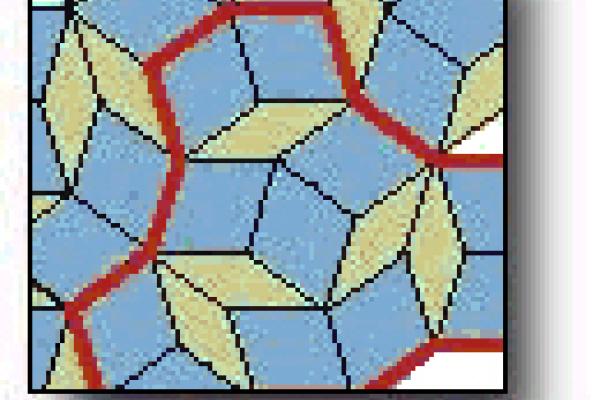
From quasicrystals to Kleenex

This pattern with kite-shaped tiles can be extended to cover any area, but however big we make it, the pattern never repeats itself. Alison Boyle investigates aperiodic tilings, which have had unexpected applications in describing new crystal structures.
Article

On the dissecting table

Bill Casselman writes about the intriguing amateur mathematician Henry Perigal, who took his elegant proof of Pythagoras' Theorem literally to his grave - by having it carved on his tombstone.
Article
blurry image of people

Friends and strangers

Sometimes a mathematical object can be so big that, however disorderly we make the object, areas of order are bound to emerge. Imre Leader looks at the colourful world of Ramsey Theory.
Article

Model Trains

As customers will tell you, overcrowding is a problem on trains. Fortunately, mathematical modelling techniques can help to analyse the changing demands on services through the day. Tim Gent explains.
Article

Measure for measure

Can you imagine objects that you can't measure? Not ones that don't exist, but real things that have no length or area or volume? It might sound weird, but they're out there. Andrew Davies gives us an introduction to Measure Theory.
Article

Maths on the tube

During World Mathematical Year 2000 a sequence of posters were displayed month by month in the trains of the London Underground aiming to stimulate, fascinate - even infuriate passengers! Keith Moffatt tells us about three of the posters from the series.
Article

Death and statistics

Actuarial science began as the place where two branches of mathematics meet: compound interest and observed mortality statistics. Financial planning for the future is therefore rooted firmly in the past. John Webb takes us through some of the mathematics involved, introducing us to some of the colourful characters who led the way.
Article

Fishy business

'Of the myriad strategems I employ to avoid useful work, the one I most enjoy is to envision how scientists of earlier eras would have made use of modern computers.' John L. Casti tells us how today's mathematicians are using computers to carry on the work of turn-of-the-century polymath d'Arcy Wentworth Thompson, who showed how mathematical functions could be applied to the shape of one organism to continuously transform it into other, physically similar organisms.
Article

Take a break

There are many errors that can occur when numbers are written, printed or transferred in any manner. Luckily, there are schemes in place to detect, and in some cases even correct, such errors almost immediately. Emily Dixon takes a break and discovers that codes are not just for sleuths.