
The harmonics of a string
When we pluck a guitar string we hear a sound. That's because the string starts to vibrate at its resonant frequency, This frequency is what controls the pitch of the sound we hear. But at the same time the string vibrates at lots of harmonic frequencies which are each an exact multiple of the fundamental frequency.
But how can a string vibrate at lots of frequencies at once? To find out, we have made some animations.
We have modelled the wave that gives the fundamental frequency, which is called the first harmonic, by the equation
$$f_1(x,t)=\sin{x}\cos{t}.$$
The waves that give the first three harmonic frequencies, known as the second, third, and fourth harmonics, have been modelled by the equations
$$f_2(x,t) = \sin{2x}\cos{2t},$$
$$f_3(x,t) = \sin{3x}\cos{3t},$$
$$f_3(x,t) = \sin{4x}\cos{4t}.$$
Here $x$ is the space variable, represented on the horizontal axis below and $t$ is time.
The three animations show the four waves individually.
To model the string vibrating at several frequencies at once we have added up the individual expressions to get
$$h(x,t)=\sin{x}\cos{t}+a \sin{2x}\cos{2t}+b \sin{3x}\cos{3t}+c \sin{4x}\cos{4t}.$$
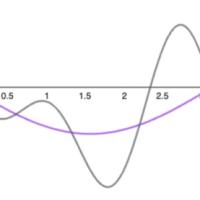
The animation below shows the first harmonic in purple and $h(x,t)$ in black. You can choose the values of the coefficients $a$, $b$, and $c$ using the sliders. They each range from $0$ to $1$. This means you can choose how much each frequency weighs in, though in this example none of them is allowed to weigh in more than the fundamental frequency.
And - tadaa - you see our hypothetical string vibrate at four frequencies at once.
About this article
This content forms part of our collaboration with the Isaac Newton Institute for Mathematical Sciences (INI) – you can find all the content from the collaboration here.
The INI is an international research centre and our neighbour here on the University of Cambridge's maths campus. It attracts leading mathematical scientists from all over the world, and is open to all. Visit www.newton.ac.uk to find out more.
