Article
hourglass with clock behind

What is time?

Everyone knows what time is. We can practically feel it ticking away, marching on in the same direction with horrifying regularity. Time has enslaved the Western world and become our most precious commodity. Turn it over to the physicists however, and it begins to morph, twist and even crumble away. So what is time exactly?
News story
3D graph

Convex is complex

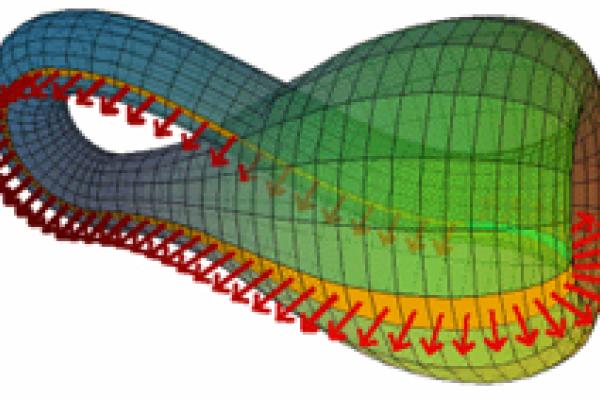
Convex or concave? It's a question we usually answer just by looking at something. It's convex if it bulges outwards, and concave if it bulges inwards. But when it comes to mathematical functions, things aren't that simple. A team of computer scientists from the Massachusetts Institute of Technology have recently shown that deciding whether a mathematical function is convex can be very hard indeed.
Article
dice

Picking holes in mathematics

In the 1930s the logician Kurt Gödel showed that if you set out proper rules for mathematics, you lose the ability to decide whether certain statements are true or false. This is rather shocking and you may wonder why Gödel's result hasn't wiped out mathematics once and for all. The answer is that, initially at least, the unprovable statements logicians came up with were quite contrived. But are they about to enter mainstream mathematics?

Article
jigsaw puzzle

Searching for the missing truth

Many people like mathematics because it gives definite answers. Things are either true or false, and true things seem true in a very fundamental way. But it's not quite like that. You can actually build different versions of maths in which statements are true or false depending on your preference. So is maths just a game in which we choose the rules to suit our purpose? Or is there a "correct" set of rules to use? We find out with the mathematician Hugh Woodin.

Article

Hidden dimensions

That geometry should be relevant to physics is no surprise — after all, space is the arena in which physics happens. What is surprising, though, is the extent to which the geometry of space actually determines physics and just how exotic the geometric structure of our Universe appears to be. Plus met up with mathematician Shing-Tung Yau to find out more.

News story
icon

Flying home with quantum physics

Quantum mechanics is usually associated with weird and counterintuitve phenomena we can't observe in real life. But it turns out that quantum processes can occur in living organisms, too, and with very concrete consequences. Some species of birds use quantum mechanics to navigate. And as Plus found out at a recent conference, studying these little creatures' quantum compass may help us achieve the holy grail of computer science: building a quantum computer.

Article

Wiring up brains

The human brain faces a difficult trade-off. On the one hand it needs to be complex to ensure high performance, and on the other it needs to minimise "wiring cost" — the sum of the length of all the connections — because communication over distance takes a lot of energy. It's a problem well-known to computer scientists. And it seems that market driven human invention and natural selection have come up with similar solutions.
Article

Solving the genome puzzle

The human genome is represented by a sequence of 3 billion As, Cs, Gs, and Ts. With such large numbers, sequencing the entire genome of a complex organism isn't just a challenge in biochemistry. It's a logistical nightmare, which can only be solved with clever algorithms.
News story
Pi

Pi day magic revealed

On March 14 2010 a mathematician and a magician teamed up to perform what they believed to be the world's largest live magic trick. The trick involved a thousand volunteers from the around the world who, using free choice, each came up with a number that was only known to themselves. And although the volunteer might be on the other side of the globe, the mathematician and the magician were able to read their mind and tell them which number they had chosen.