
New phases of matter: Abstract nonsense comes good
Brief summary
This article explores so-called topological phases of matter and how category theory is needed to describe them. It is the third of a three part series looking at the rise of category theory in physics.
The quantum Hall effect, which we introduced in the previous article, is one of the most curious phenomena in physics. Not only does it make quantum effects visible on a macroscopic level, but it also provides new exotic types of matter. These exist when the magnetic field is such that the Hall conductance is on a plateau. A phase transition occurs when the magnetic field is changed enough for the Hall conductance to move to a new plateau.
The new phases of matter are known as topological orders, a notion which was first introduced by Xiao-Gang Wen, a theoretical physicist at MIT, in 1989. Similar phases are observed in other systems, such as topological insulators. Because of their robustness, topological phases are interesting in the quest to build quantum computers. The greatest current challenge to this quest is the fact that the quantum system they are made out of are too easily destroyed. "It turns out that these [exotic] phases of matter are exactly what [you want] to build quantum computers," says Frank Verstraete, Leigh Trapnell Professor of Quantum Physics at the University of Cambridge. "It was Alexi Kitaev, an absolute genius, who first understood this."
But how are those topological phases related to the symmetry breaking that gives rise to ordinary phases of matter? The question troubled physicists for quite a while after the quantum Hall effect was discovered. One thing they focussed on was the existence of several types of ground state, as they appear in the fractional version of the effect, where one cycle of Laughlin's theoretical pump takes you from one ground state to another.
At first glance a multiplicity of ground states (also called ground state degeneracy) isn't new. In our description of symmetry breaking in a magnet, the global magnetic field that emerges when the symmetry has been broken could point in any direction — and each orientation corresponds to a ground state. However, a simple rotation will turn one ground state into the other. The ground states are related to each other by exactly the kind of symmetry that has been broken.
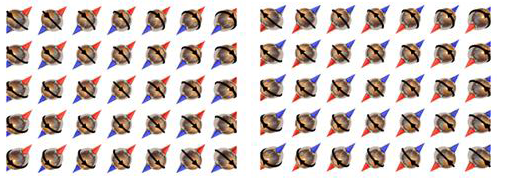
It's natural to believe that the ground state degeneracy in the quantum Hall effect also comes from symmetry breaking. But this idea was shattered in 1989, when Xiao-Gang Wen and Qian Niu proved that traditional symmetry is irrelevant to the ground state degeneracy. Wen and Niu's paper showed that the multiplicity of ground states was instead a consequence of the topology of the system.
Topological order
To get the gist of Wen and Niu's results we first need to again consider a theoretical set-up of the fractional quantum Hall effect. In the lab, the material in question forms a rectangular sheet. For theoretical calculations of what happens inside the sheet its edges are annoying. As we saw in the previous article, their presence changes the physics. But as we also saw in the previous article, the physics at the edges is related to the physics in the interior. It's therefore ok to pretend the edges aren't there — you can still capture all the important physics that happens in the experiment.
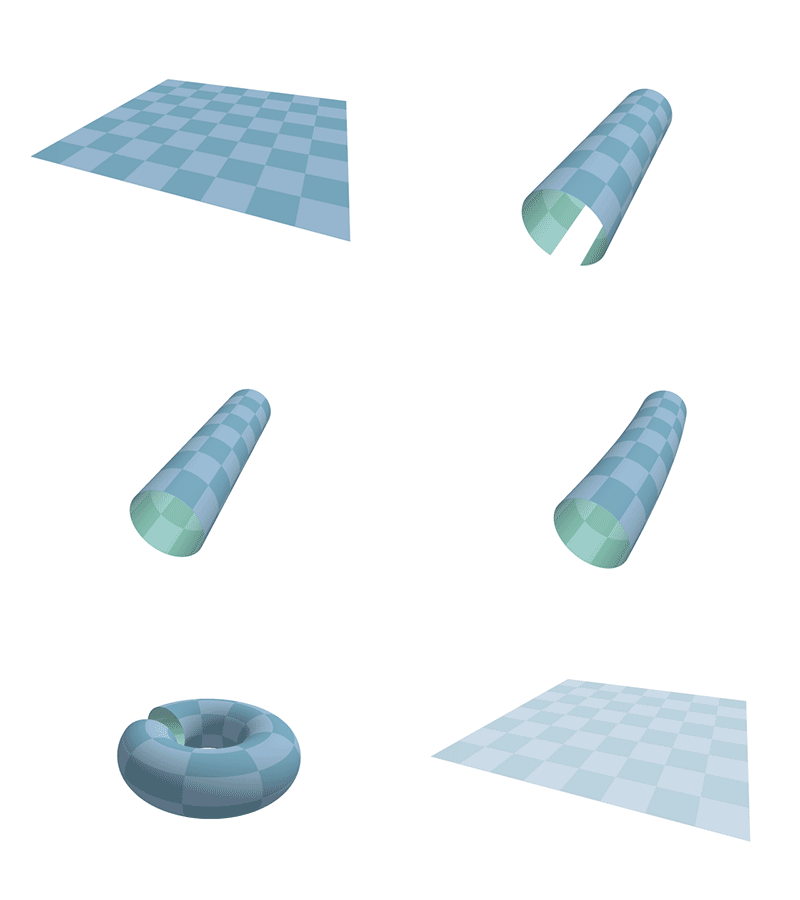
One way of ignoring the edges is to imagine that, as you leave the sheet through the right-hand edge you re-emerge through the left-hand edge, and as you leave through the top edge you re-emerge through the bottom edge (this is essentially what Laughlin did in his pump argument). When you are doing this you might as well imagine bending the sheet around to glue the right-hand edge to the left-hand edge to get a cylinder. You then glue the top edge to the bottom edge bending the cylinder around to get a ring shape which is technically known as a torus.
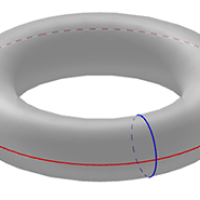
A torus has one hole. Topologically, this is what differentiates it from other shapes. The transformations allowed by topology — squeezing and stretching, but no tearing — can't make the hole go away and they can't create any extra holes. The fact that there's one hole is a topological invariant of the torus.
There are two ways you can wind once around the hole of the torus, as shown below.
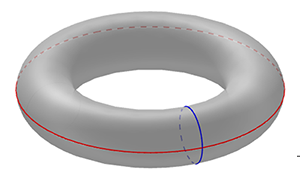
Wen and Niu showed that when fractional quantum Hall states are placed on a shape like a torus, their ground-state degeneracy is determined purely by the topology of the shape. For example, for so-called Laughlin states, if the filling fraction of the highest Landau level is $1/q$, then on an ordinary torus there'll be q different ground states. And you can take this game further. If you place the system on a torus with 2 holes, there'll be $q^2 $ground states. If it's a torus with 3 holes, there'll be $q^3$ ground states — and so on. It's the topology — the number of holes — which determines the number of ground states. Not the microscopic details of the system.
The behaviour of the quasi-particles we mentioned above, the anyons, is crucial in all this. Slowly transporting an anyon around the holes of the surface the system lives on can transform one ground state into another. What differentiates different phases of the system is not the breaking of a symmetry. It's the types of anyons that can exist and the rules governing the way they fuse and braid around each other as they move through space and time. A phase transition corresponds to a sudden change in these rules.
Abstract nonsense comes good
All this brings us back to where we started. Landau's original description of phase transitions involved symmetries and symmetry breaking. Group theory provides an abstract language for talking about symmetries. It doesn't matter whether you're thinking of the symmetries of a square, the symmetries that characterise liquid water, or even the symmetries that prevailed in the early Universe — the operations involved always form a mathematical group. Whatever you can say about an abstract group automatically applies to all the objects or systems whose symmetries realise the group. Abstraction is a powerful tool.
But what about topological phases of matter that are not produced by ordinary symmetry breaking? How should we talk about them?
This is where category theory enters the picture. The theory was first developed in the 1940s by pure mathematicians Samuel Eilenberg and Saunders Mac Lane. A category consists of a family of abstract objects and morphisms between pairs of objects. You might imagine the objects as blobs and morphisms as arrows that point from one blob to another blob. They indicate some sort of relationship between the corresponding objects. Finally there's a rule for how two arrows can combine (see here for the details).
The definition appears so abstract as to be meaningless, but here's a simple example of a category: think of the natural numbers 1, 2, 3, 4, …. Draw an arrow from a number n to a number m if n < m. There's an obvious way of combining two arrows. If n < m < l then n < l, so the arrow from n to m combined with the arrow from m to l gives an arrow from n to l.
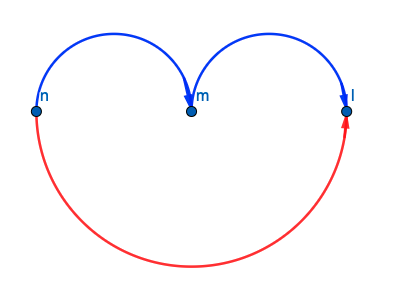
This category reflects the natural numbers and their ordering, but the abstraction feels unnecessary. "A big problem is that people think, 'category theory is really deep, so let me try and [phrase] something that's really [simple] in terms of category theory,'" concedes Verstraete. "It's misused a lot and in many cases it's overkill."
When it comes to topological phases of matter, however, the language of category theory gains tangible meaning. There are certain types of categories, called modular tensor categories, which can exactly express the behaviour and interaction of the anyons that are so important in these systems. The objects in these categories are types of anyons and the morphisms encode how anyons can combine and transform.
Different phases of a system like the fractional quantum Hall effect correspond to different modular tensor categories. So as the system undergoes a phase transition, the previous modular tensor category seizes to apply and a new one does. Modular tensor categories are seen as generalised versions of ordinary symmetries. "What is topological order? It's the breaking of these generalised symmetries," says Liang Kong, Research Fellow at the International Quantum Academy.
In your face
The relevance of category theory to this area of physics wasn't discovered overnight, but emerged gradually over the 1990s and 2000s. Initial acceptance was slow. "One of the earliest papers on the applications of category theory in physics is Moore and Seiberg's 1988 paper Classical and quantum conformal field theory," says Kong. "They wrote, 'We will need to use some very simple notions of category theory, an esoteric subject noted for its difficulty and irrelevance.' This reflects the very natural reactions of physicists to the abstract nonsense of category theory, which is still very common today."
Subsequently, the work of many researchers, including Kong and Versraete, has gradually shown that category theory is not just a convenient language for topological phases, but the correct structural framework to talk about their various phenomena in a unified way. "It is only really becoming clear now that if you want to understand [this physics, you can't get around] category theory," says Versraete. "It's right there in your face."
Kong concedes that some physicists face a psychological barrier when it comes to engaging with category theory. There's a similarly esoteric construct, called set theory, whose abstraction is so powerful, it serves as the language in which the very foundations of mathematics are described (you can find out more in this article). "Physicists' reaction to set theory is likely to be the same [as their reaction to category theory: they find it] formal, dry, uncomputable and useless," Kong has written in a paper co-authored with Zhi-Hao Zhang. But while physicists can safely ignore set theory in their everyday work, the basic notions of category theory can't be bypassed.
It's no surprise, then, that category theory was a running theme at the Quantum field theory with boundaries, impurities, and defects programme at the Isaac Newton Institute, which Verstraete helped to organise and in which Kong took part. The programme provided the time and space for researchers to exchange ideas, and relevant new results emerged as a result.
The benefit of the interaction runs both ways. "Not only has category theory had an impact on physics, but the new developments in physics also strongly influenced the development of mathematics," says Kong. "A lot of the questions and conjectures coming out of physical study are now gradually being studied and proved by mathematicians. These mathematical developments are completely inspired by physics."
It's by no means the first time that pure mathematics and physics cross-fertilise to stunning effect. We have already mentioned the role of group theory in physics. Another example are developments in 19th century geometry, which provided just the language Albert Einstein needed for his general theory of relativity. A more recent example comes from an INI programme which explored the links between the physics of black holes and number theory.
Places like the INI exist precisely to enable cross-boundary exchange. By hosting research programmers that explore the full breath of mathematics, from the very applied to the furthest reaches of esoteric pure maths, the INI helps build the foundations of technological advances of the future. It'S blue sky research to maximal effect.
About this article
Liang Kong is Research Fellow at the International Quantum Academy.
Frank Verstraete is Leigh Trapnell Professor of Quantum Physics at the University of Cambridge. You can find out more about his work in this article and about a popular book on quantum mechanics he has co-authored in this podcast.
Verstraete was one of the organisers of a research programme called Quantum field theory with boundaries, impurities, and defects, which took place at the Isaac Newton Institute for Mathematical Sciences (INI) in Cambridge in 2025. Kong was one of the participants.
Marianne Freiberger, Co-Editor of Plus, interviewed Verstraete and Kong in November 2025.
This article was produced as part of our collaboration with the Isaac Newton Institute for Mathematical Sciences (INI) – you can find all the content from the collaboration here.
The INI is an international research centre and our neighbour here on the University of Cambridge's maths campus. It attracts leading mathematical scientists from all over the world, and is open to all. Visit www.newton.ac.uk to find out more.
