

The Quantum Hall Effect: Protected by topology
Brief summary
This article looks at the quantum Hall effect and its link to the mathematical area of topology. It is the second of a three part series looking at the rise of category theory in physics.
The quantum Hall effect was first discovered by Klaus von Klitzing in 1980. Klitzing was studying a phenomenon that had first been observed around a hundred years earlier by Edwin Herbert Hall.
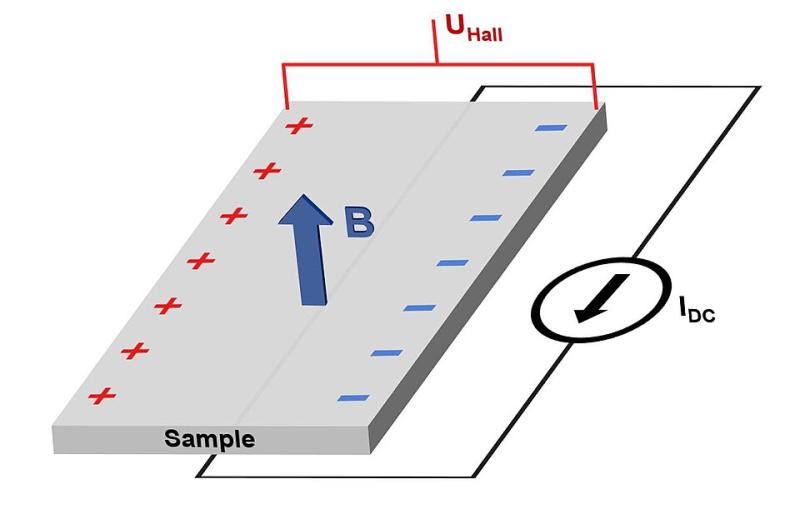
If you take a thin sheet of gold, turn on a magnetic field perpendicular to the sheet, and run a constant current along one direction of the sheet, then a current (called the Hall current) is produced in the perpendicular direction along the sheet.

,
The strength of the magnetic field determines the ease with which the Hall current can flow: the stronger the field the lower the Hall conductance (which measures this ease). If you gradually increase the strength of the magnetic field, the Hall conductance decreases in a nice and steady fashion in line with the magnetic field.
Klitzing wondered what would happen if you conducted the experiment at very low temperatures when electrons aren't jostled about by thermal energy. What he found was astonishing: as he decreased the strength of the magnetic field, the Hall conductance no longer decreased steadily. Instead it proceeded in jumps. Such behaviour, quantities changing in seemingly discrete steps, is the hall-mark of all things quantum. And because quantum effects can't usually be observed in macroscopic systems, Klitzing's discovery was very interesting indeed. He had made quantum effects become visible.
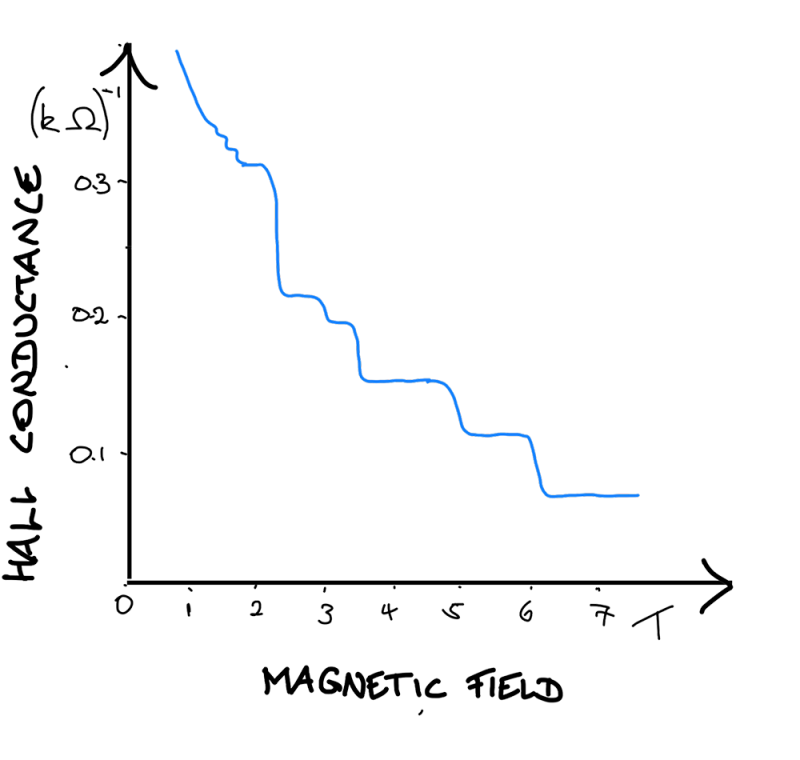
The quantised values of the Hall conductance are of the form
$$e^2/h, 2 e^2/h, 3 e^2/h, 4 e^2/h, 5e^2/h,...$$
and so on, where $e$ is the electron charge and $h$ is a number known as Planck's constant. Because integers appear in these expression the effect became known as the integer quantum Hall effect.
But this wasn't all. A little later Horst Störmer and Daniel Tsui performed a similar experiment (using a very thin layer of an electron gas) at even lower temperatures and with a stronger magnetic field. Surprisingly they saw new levels appear in between the integer levels seen in Kitzing's experiment. This effect became known as the fractional quantum Hall effect.
Kitzing received the 1985 Nobel Prize in Physics for the discovery of the integer quantum Hall effect. Horst Störmer and Daniel Tsui received the Nobel Prize in Physics in 1998 for their work, shared with Robert Laughlin, from whom we'll hear more below.
Getting into a quantum state
The integer quantum Hall effect is so exact, it is used as a yardstick by which to measure units of electrical resistance (the reciprocal of conductance). And although it comes about in macroscopic systems, it can be used to measure the charge of an individual electron to high accuracy.
Amazingly, the precision is brought about, not by perfection, but by impurities. To understand how this is possible we first need to engage with a minimum of quantum mechanics. In classical physics the state of a particle (or an entire system of particles) at a given moment in time is given by definite quantities, like the position and momentum of (each of) the particle(s). Quantum mechanics, however, is more fuzzy. Particles can be in several places at once and have several momenta at once. It's only when you make a measurement that reality snaps into one of the possible outcomes.
The quantum state of a particle, or a system, encodes all the multiple possibilities as well as the probability that you'll observe each one. Mathematically it is represented by a so-called wavefunction. When we say that a state extends across a region of space we mean that the particle could be found anywhere in the region, were you to measure its location, but not outside it.
Another feature of quantum mechanics is the discreteness we already alluded to above: quantities you'd usually expect to vary continuously instead take on discrete values.
There's no way of getting around the counter-intuitive nature of quantum mechanics. See here if you'd like to find out a little more.
Quantum Hall by integers: Why plateaux?
When it comes to explaining the integer quantum Hall effect, discreteness is the first quantum feature we come across. In the experiment, the material in question (for example, Hall’s thin gold sheet) is exposed to a strong magnetic field. This field alters the motion of the electrons within. In particular, the energy associated with their motion cannot take arbitrary values: only certain discrete values of energy, called Landau levels, are allowed.
Another central tenet of quantum mechanics, known as the Pauli exclusion principle, implies that only a finite (albeit very large) number of electrons can occupy a given Landau level. This number is related to the strength of the magnetic field. The stronger the field, the more electrons each Landau level can accommodate.
In an ideal material, each electron would occupy one of these exact Landau levels. The corresponding quantum states would be extended across the sample, allowing all electrons to contribute to electrical transport.
No physical system is completely ideal, however. Real materials (such as said gold sheet) are bound to contain some impurities, which disturb the precision of the Landau levels. In the vicinity of impurities electrons are allowed to exist at energy levels a little lower or higher than an exact Landau level. Each Landau level broadens into a Landau band of allowed energies.
But while impurities extend the range of allowed energies, they also serve to trap electrons, confining their motion to small nearby regions. Electrons in such localised states cannot contribute to electrical transport. The vast majority of electrons will be thus trapped, which begs the question of how a current can flow at all.
The answer comes from the edges of the material (e.g. the edge of the gold sheet). The boundary alters the allowed motion. Just as the edge of a river disrupts small eddies and guides the water into a smooth flow, the edge of the sample guides electrons along one-way paths. It is along these edge channels that current flows. The edges also change the energy landscape causing the Landau levels to "bend upwards": the value of the energy of a Landau level increases as you approach the edge.
Now imagine the experiment is up and running, with a Hall current flowing along the edges. Then imagine decreasing the magnetic field. As the field weakens, each Landau band can accommodate fewer electrons — because as we said above, the number of electrons per Landau level depends on the strength of the magnetic field. Some electrons will no longer find room in lower energy states and must therefore enter higher energy states that previously weren't occupied.
But these additional electrons will mainly enter localised states, created by impurities, in the interior of the sample. Because these states cannot contribute to electrical transport, the Hall conductance stays constant, forming a plateau. Only when electrons begin to occupy new extended states, states that aren't localised, does the Hall conductance change rapidly to the next plateau.
Quantum Hall by integers: Why integers?
This explains the existence of plateaux in the graph that plots Hall conductance against magnetic field strength. But why do these plateaux correspond exactly to values of the Hall conductance that are integer multiples of e2/h? In 1981 the physicist Robert Laughlin came up with a theoretical set-up of the experiment which allowed him to investigate the system with surgical precision.
In this theoretical construction, the system turns into a sort of pump. The electric field which drives the Hall current is produced by a magnetic flux that is slowly threaded through the system (whose geometrical lay-out is imagined to contain a hole to thread a flux through). A single cycle of the pump corresponds to passing through one quantum (one chunk) of magnetic flux. After each pump cycle the system returns to what it was like before. (Using technical language, a mathematical object called the Hamiltonian of the system returns to what it was like before.)
A calculation shows that the charge transported in one pump cycle (measured in units of e), is the Hall conductance of the system (in units of e2/h). To explain the appearance of precise integer multiples of e2/h in the Hall conductance, you need to show that the same integer number of electrons is transported during each pump cycle.
In classical physics this would be obvious. Electrons are indivisible, so only an integer number can be transported, and each pump cycle is exactly the same, so it must be the same integer number each time. But quantum physics is more fuzzy so more work is needed to show that this is indeed what happens. When you do the calculations, you will come across a formula known from an area of maths called topology. You can prove mathematically that this formula can only ever return integers (known as Chern numbers). This fact ensures that an integer number of electrons are transported in Laughlin's pump argument, which in turn explains the values of the Hall conductance. (You can read more here.)
This is a wonderful confluence of mathematics and nature: behind the quantisation of the Hall conductance lies the mathematical necessity that Chern numbers be integers!
Protected by topology
Although Laughlin's set-up is rather ideal, the argument explains the exact quantisation of the Hall conductance even in real experiments. It also explains why the phenomenon is so robust. Small changes to the nature of the system — the number of electrons, the nature of the impurities, the magnetic field — can't knock the Hall conductance off its integer-multiple value. Because Chern numbers can only ever be integers, the Hall conductance has no choice but to take the specific values it does, even if you perturb the details of the system.
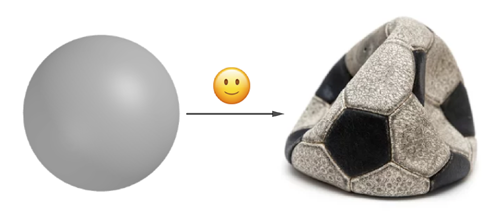
This resistance to small changes echoes what happens in topology, the area of maths that gives us the Chern number formula mentioned above. Topology is a more lenient form of geometry. Two shapes are considered topologically the same if you can deform them into each other without tearing or cutting. A perfectly round sphere is topologically equivalent to a deflated football, and a doughnut to a one-handled mug. A small deformation of a shape therefore doesn't change its topological type — just like a small change to the quantum Hall system does not change its Hall conductance.
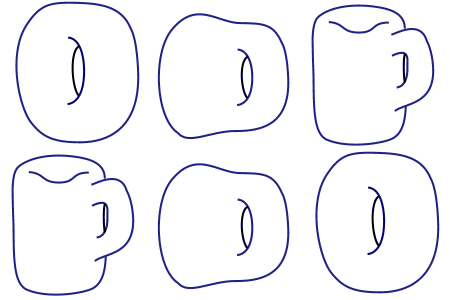
Because of these links to topology (and some deeper connections too) physicists say that the Hall conductance is topologically protected.
Another feature to notice is that the interior (the bulk) of the system is an insulator. Current flows only along the edges. However, you can't consider the physics at the edges without considering the physics of the bulk. What happens at the edges is a direct consequence of the physics of the entire system. This phenomenon is known as the bulk-edge correspondence.
Quantum Hall by fractions
This throws some light on the integer quantum Hall effect, but what about the fractional quantum Hall effect? As explained above, the fractional Hall effect happens at lower temperatures and at high strengths of the magnetic field. In the curve plotting the Hall conductance against the strength of the magnetic field, new plateaux emerge at values that are not integer multiples of $e^2/h$. The multiples $\frac{1}{3} e^2/h$ and $\frac{2}{5} e^2/h$ are the ones most prominently seen in experiments, but many others have been observed too.
In the low-temperature regime, interactions between electrons become crucial. While these interactions are always present, at higher temperatures thermal fluctuations destroy the delicate collective quantum states they can produce. At sufficiently low temperatures, however, the electrons can organise into a highly correlated many-body system — a quantum fluid — that responds to external perturbations as a single entity. (Quantum fluids exhibit a lot of entanglement, another of the phenomena we don't observe in classical physics.)
An explanation of the fractional quantum Hall effect again originated with Laughlin. When the highest Landau level in the system is only partially filled by a certain filling fraction, such as 1/3rd, the system can stabilise into a lowest energy ground state, which is just the kind of highly correlated quantum fluid mentioned above. We can again evoke the pump argument which shows, as before, that the Hamiltonian returns to itself after one pump cycle.
But while the Hamiltonian, which describes the overall nature of the system, returns to itself, the exact state of the system, given by its wavefunction, does not. The system finds itself in a different groundstate from the one it started in, described by a different wavefunction. It takes 3 pump cycles (if the filling fraction of the Landau level is ⅓) for the system to return to its original ground state. The original pump argument then works for these 3 cycles taken together: they pump across an integer number of electrons.
What happens during one pump cycle? The answer is that a fractional charge of 1/3rd is pumped across. Since electrons are indivisible, they can't carry this fractional charge. Instead it is carried by excitations of the quantum liquid. There's a sense in which these excitations look a bit like particles travelling across the system, which is why they are also known as quasi-particles. But they are not entities in their own right as electrons are — they emerge as the collective response of the quantum liquid to the magnetic and electric fields.
The Hall conductance is again given by the charge transported during one pump cycle, which is now fractional. Plateaux — ranges of magnetic field over which the conductance remains constant — arise for the same reason as in the integer quantum Hall effect: impurities localise low-energy quasi-particles, preventing them from contributing to transport of charge. As before the system is robust to small changes: the Hall conductance is topologically protected
The quasiparticles at play here are called anyons. The name was suggested by Nobel laureate Frank Wilczek. It's based on the word "anyone" and alludes to the fact that anyons fall into neither of the two classes that ordinary particles belong to (which are bosons and fermions).
The quantum Hall effect is more than just a curious oddity. When the magnetic field is such that the Hall conductance is on a plateau the system behaves like a new type of material - it represents a topological phase of matter to be precise. Such topological phases have surprising applications, for example in quantum computing. And they require a new type of mathematics. Find out more in the next article.
About this article
Liang Kong is Research Fellow at the International Quantum Academy.
Frank Verstraete is Leigh Trapnell Professor of Quantum Physics at the University of Cambridge. You can find out more about his work in this article and about a popular book on quantum mechanics he has co-authored in this podcast.
Verstraete was one of the organisers of a research programme called Quantum field theory with boundaries, impurities, and defects, which took place at the Isaac Newton Institute for Mathematical Sciences (INI) in Cambridge in 2025. Kong was one of the participants.
Marianne Freiberger, Co-Editor of Plus, interviewed Verstraete and Kong in November 202. She would like to thank David Tong, Professor of Theoretical Physics at the University of Cambridge, for his help with this article and for his brilliant lecture notes on the quantum Hall effect.
This article was produced as part of our collaboration with the Isaac Newton Institute for Mathematical Sciences (INI) – you can find all the content from the collaboration here.
The INI is an international research centre and our neighbour here on the University of Cambridge's maths campus. It attracts leading mathematical scientists from all over the world, and is open to all. Visit www.newton.ac.uk to find out more.
