Content about “symmetry”

Article
Detail of M-theory multiple, Grenville Davey. Image © Isaac Newton Institute

String Theory, Duality and Art: how the Higgs boson and Turner Prize collide

On the face of it, an artist and a theoretical physicist might seem an unlikely pairing. But Turner Prize-winning sculptor Grenville Davey and string theorist David Berman's collaboration is producing beautiful, thought-provoking work inspired by the fundamental structure of the Universe. Julia Hawkins interviewed them to find out more about how the Higgs boson and T-duality are giving rise to art.
Article
Design

Secret symmetry and the Higgs boson (Part II)

In the first part of this article we explored Landau's theory of phase transitions in materials such as magnets. We now go on to see how this theory formed the basis of the Higgs mechanism, which postulates the existence of the mysterious Higgs boson and explains how the particles that make up our Universe came to have mass.

Article
spins

Secret symmetry and the Higgs boson (Part I)

It's official: the notorious Higgs boson has been discovered at the Large Hadron Collider at CERN. The Higgs is a subatomic particle whose existence was predicted by theoretical physics. Also termed the god particle, the Higgs boson is said to have given other particles their mass. But how did it do that? In this two-part article we explore the so-called Higgs mechanism, starting with the humble bar magnet and ending with a dramatic transformation of the early Universe.
Podcast

Imaginary Barcelona

Imaginary is an interactive mathematics exhibition that inspires the imagination with beautiful images. And what is more exciting it allows anyone to step into the world of maths and play with beautiful mathematical surfaces, symmetry and much more. We went along to the Imaginary Barcelona conference, which brought together people involved in the original exhibition in Germany and its recent successful run throughout Spain.
News story
icon

Shattering crystal symmetries

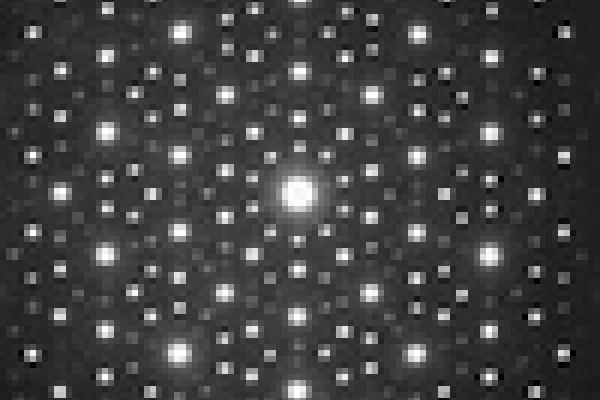
In 1982 Dan Shechtman discovered a crystal that would revolutionise chemistry. He has just been awarded the 2011 Nobel Prize in Chemistry for his discovery — but has the Nobel committee missed out a chance to honour a mathematician for his role in this revolution as well?
Article
Tesselating shapes

The trouble with five

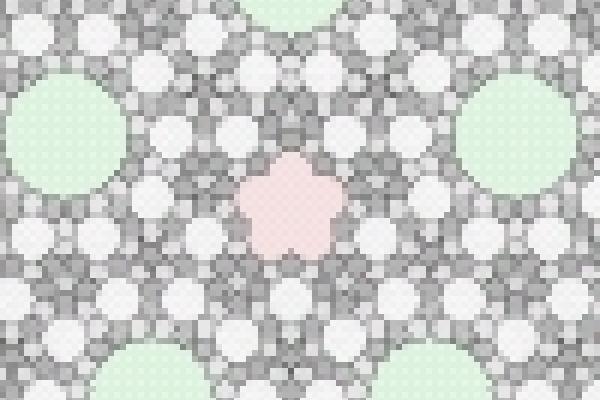
Squares do it, triangles do it, even hexagons do it — but pentagons don't. They just won't fit together to tile a flat surface. So are there any tilings based on fiveness? Craig Kaplan takes us through the five-fold tiling problem and uncovers some interesting designs in the process.