
Home
plus.maths.org

Secondary menu

  • My list
  • About Plus
  • Sponsors
  • Subscribe
  • Contact Us
  • Log in
  • Main navigation

  • Home
  • Articles
  • Collections
  • Podcasts
  • Maths in a minute
  • Puzzles
  • Videos
  • Topics and tags
  • For

    • cat icon
      Curiosity
    • newspaper icon
      Media
    • graduation icon
      Education
    • briefcase icon
      Policy

    Popular topics and tags

    Shapes

    • Geometry
    • Vectors and matrices
    • Topology
    • Networks and graph theory
    • Fractals

    Numbers

    • Number theory
    • Arithmetic
    • Prime numbers
    • Fermat's last theorem
    • Cryptography

    Computing and information

    • Quantum computing
    • Complexity
    • Information theory
    • Artificial intelligence and machine learning
    • Algorithm

    Data and probability

    • Statistics
    • Probability and uncertainty
    • Randomness

    Abstract structures

    • Symmetry
    • Algebra and group theory
    • Vectors and matrices

    Physics

    • Fluid dynamics
    • Quantum physics
    • General relativity, gravity and black holes
    • Entropy and thermodynamics
    • String theory and quantum gravity

    Arts, humanities and sport

    • History and philosophy of mathematics
    • Art and Music
    • Language
    • Sport

    Logic, proof and strategy

    • Logic
    • Proof
    • Game theory

    Calculus and analysis

    • Differential equations
    • Calculus

    Towards applications

    • Mathematical modelling
    • Dynamical systems and Chaos

    Applications

    • Medicine and health
    • Epidemiology
    • Biology
    • Economics and finance
    • Engineering and architecture
    • Weather forecasting
    • Climate change

    Understanding of mathematics

    • Public understanding of mathematics
    • Education

    Get your maths quickly

    • Maths in a minute

    Main menu

  • Home
  • Articles
  • Collections
  • Podcasts
  • Maths in a minute
  • Puzzles
  • Videos
  • Topics and tags
  • Audiences

    • cat icon
      Curiosity
    • newspaper icon
      Media
    • graduation icon
      Education
    • briefcase icon
      Policy

    Secondary menu

  • My list
  • About Plus
  • Sponsors
  • Subscribe
  • Contact Us
  • Log in
  • Schrödinger's cat

    Advent calendar door #8: Schrödinger's equation, what does it mean?

    8 December, 2025

    Behind the last two doors we met Schrödinger's equation and seen it in action. But what does that all mean? How should we interpret its solution, the wave function? And what does that tell us about the physical world? We spoke to to Tony Short and Nazim Bouatta, both theoretical physicists at the University of Cambridge, to find out.

    They explained why, despite the wave-particle duality of all matter, we don't see big objects like tables, chairs or ourselves behaving in a wavey way. We got a glimpse of some of the deep philosophical questions that arise: Is a particle spread out in a weird wavey goo? Or is the wave function merely a mathematical tool to provide the probabilities of where a particle could be located?
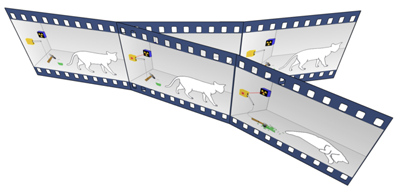
    An illustration of the many worlds interpretation of Everett: A film strip of Schrodinger's cat splits into two separate strips - one showing the cat alive and one showing it dead.
    According to the Everett interpretation, when you open the box to check on Schrödinger's cat the world splits into two branches: the cat is alive in one world and dead in the other. (Image: Dc987)

    One of the most fascinating idea to come out of all of this is the many worlds view of what the wave function is telling us: the idea is that there are different worlds that are all real and in each of them the particle is in a different position. This is already pretty weird when you're only thinking of tiny little particles. But what about us, the observers? If you include them in this many worlds view, you get the so-called Everett interpretation of quantum mechanics (named after the physicist Hugh Everett).

    Imagine that. Perhaps one of those other versions of you is sitting in another version of the world reading this article but drinking a cup of tea rather than a cup of coffee! But if that's true, then why are we never aware of these other copies of ourselves?

    You can find out the answer to this and much more in our article Schrödinger's equation — what does it mean?

    Back to the Plus advent calendar 2025

    • Log in or register to post comments

    You might also like

    article
    icon

    Schrödinger's equation — what does it mean?

    In the first article of this series we introduced Schrödinger's equation and in the second we saw it in action using a simple example. But how should we interpret its solution, the wave function? What does it tell us about the physical world?

    Read more about...

    advent calendar 2025

    Our Podcast: Maths on the Move

    Our Maths on the Move podcast brings you the latest news from the world of maths, plus interviews and discussions with leading mathematicians and scientists about the maths that is changing our lives.

    Apple Podcasts
    Spotify
    Podbean

    Plus delivered to you

    Keep up to date with Plus by subscribing to our newsletter or following Plus on X or Bluesky.

    University of Cambridge logo

    Plus is part of the family of activities in the Millennium Mathematics Project.
    Copyright © 1997 - 2025. University of Cambridge. All rights reserved.

    Terms