Student interview - Alexander Langley
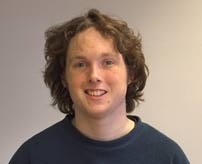
Alexander Langley
Alexander is in his first year of a BSc degree course in Mathematics at Sheffield Hallam University. It is a four year course and he will have a work placement in the third year.
Alexander Langley
Alexander is in his first year of a BSc degree course in Mathematics at Sheffield Hallam University. It is a four year course and he will have a work placement in the third year.
Mike Yates looks at the life and work of wartime code-breaker Alan Turing. Find out what types of numbers we can't count and why there are limits on what can be achieved with Turing machines.
I really want to know more about Goldbach conjecture, would you mind sending me the source code of your Goldbach conjecture calculator.
Andy Leung
Have a look at this issue's Mathematical mysteries: Goldbach revisited.
A request from Garrod Musto who is currently a maths teacher at Kingswood School in Bath.
For many years educationalists have talked about "Relevancy of the Curriculum", and "maths in context", with a view to preparing pupils for everyday life, and thus the importance of "real world applications".
NRICH has established a worldwide following with registrations of new members and schools increasing at a rate of 50 per month. All materials are freely available on the Internet and registration (also free) is only necessary in order to submit solutions for publication, join the mailing lists or use the "Ask a Mathematician" Answering Service.
Over four hundred teachers and lecturers attended this year's Annual Conference of The Mathematical Association.
"maths-gcse-a" is being set up to provide a forum for mathematics teachers at secondary level. Messages sent to the list may cover the following topics (this list is far from exhaustive):
Since we first wrote about the Goldbach Conjecture we've had many requests for more information about it and about how our Goldbach calculator works. We answer some of your questions here but the Goldbach conjecture touches on a strange area of maths that may leave you even more curious than before...
Are your multiplication problems real or imaginary?