ICM 2026: A postcard from Philadelphia
Brief summary
We report on our experience at the 2026 International Congress of Mathematicians, including a hot debate surrounding the relationship between mathematics and artificial intelligence.
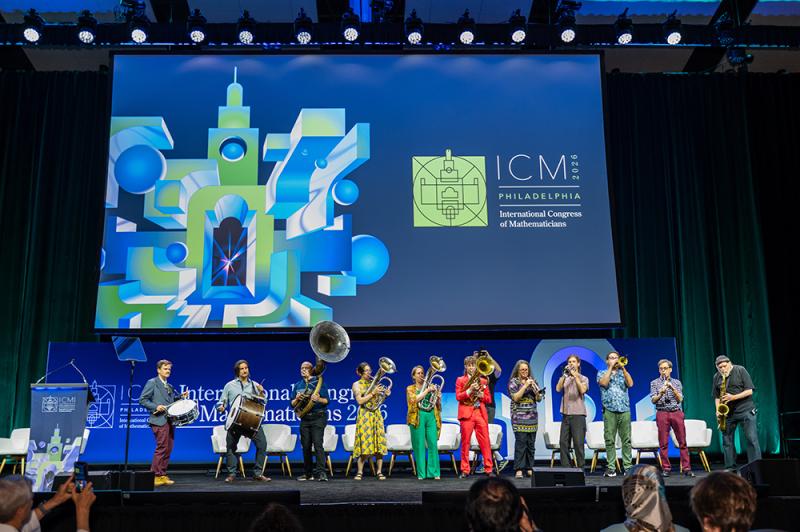
This July we, along with nearly three thousand other mathematicians, were welcomed by hot weather, cold air conditioning, and fantastic mathematics at the 2026 International Congress of Mathematicians in Philadelphia. The West Philadelphia Orchestra kicked off the event by marching through the huge auditorium, the brass band adding to the celebratory atmosphere of the opening ceremony as we waited for the awarding of some of the most prestigious prizes in mathematics.
The best-known of the prizes are the Fields Medals, which were awarded to Yu Deng, John Pardon, Jacob Tsimerman and Hong Wang "to recognise outstanding mathematical achievement for existing work and for the promise of future achievement". Shayan Oveis Gharan received the Abacus Medal, which like the Fields Medal is given to mathematicians under the age of 40, but for contributions to theoretical computer science. Oveis Gharan's contributions include breaking a 50-year-old limit on the approximation factor for a tricky puzzle known as the travelling salesperson problem.
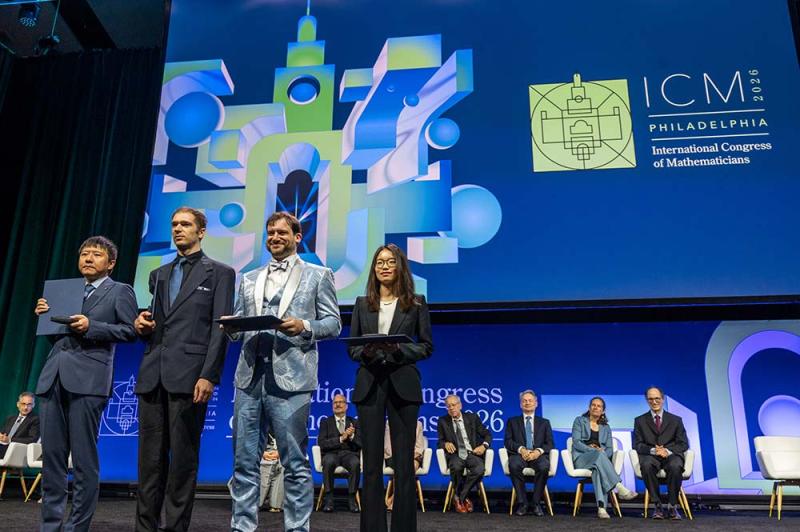
Yurii Nesterov was awarded the Gauss Medal for his groundbreaking work on mathematical optimisation techniques (including accelerated gradient-descent) that are now ubiquitous in machine learning and artificial intelligence. At the press conference after the ceremony he joked that the recognition was very unexpected: "Applied mathematicians don't get prizes from pure mathematicians very often!"
The Chern Medal was awarded to UK mathematician Graeme Segal, recognising his "visionary mathematical insights, that have had an enduring influence in a wide range of fields". Fellow UK mathematician and our colleague here at Cambridge, Hannah Fry, won the Leelavati Prize for "translating mathematics into a language of wonder and relevance for the public without diminishing its scope and importance."
After the announcement of the prizes Hiraku Nakajima, President of the International Mathematical Union (IMU), moved on to the "interesting part of the programme", including the decisions made at the IMU's General Assembly held in New York just a few days earlier. And very interesting it was too, particularly for those of us from the UK. Ulrike Tillmann, outgoing Director of the Isaac Newton Institute for Mathematical Sciences, was voted in as the incoming President of the IMU (you can read more here). And the team from Glasgow and Dublin were successful in their bid to host the 2030 ICM and IMU General Assembly.
AI versus mathematics?
As we dove into the programme over the following days, a strong thread quickly emerged: the relationship between mathematics and artificial intelligence. With AI now beginning to generate mathematical proofs in abundance, where does that leave the field?
Fields Medallist Jacob Tsimerman's announcement that he was temporarily stepping away from mathematics to work for Google Deepmind (he remains a professor at the University of Toronto) generated some shock waves. A few days later he ended his Fields Medal lecture suggesting that in the next few years AI will become superhuman at maths, producing proofs but also proposing conjectures and insightful definitions. "I believe that some version of maths as it exists today will be lost - and it's ok to grieve that."
The public lecture by 2006 Fields Medallist Terence Tao left us feeling a bit more optimistic. Tao likened the current situation to the foundational crisis of the early twentieth century, unleashed by discoveries such as Russell's paradox and Gödel's incompleteness theorems. Mathematics survived that crisis to emerge stronger, and Tao believes our community can also survive the challenges brought by AI. It's a question of formulating a community response, he said, by (re-)defining our goals.
When it comes to open problems, for example, Tao said we may want to aim for more than just finding solutions. More value could be placed on the verification of solutions (as he pointed out, no one ever gets a medal for peer reviewing maths papers), the clarity of the exposition of solutions, and having them digested by the community. He suggested that the unspoken goal of all mathematicians is for their work to become part of the mathematical canon – the accepted theory that is taught to the next generation of mathematicians. This canonisation, Tao said, is least amenable to optimisation by AI tools but the most valuable part of the entire process. Here is a recording of Tao's talk.
Other discussions echoed the idea that maths is more than just proofs. A live recording of the Joy of why podcast, hosted by Steven Strogatz and Janna Levin and featuring Alex Kontorovich, AMS President Ravi Vakil, and 2018 Fields Medallist Akshay Venkatesh, emphasised the value of storytelling in mathematics — filling the cracks between the proofs and creating a coherent, and illuminating, whole. As Vakil put it, "We don't just prove random stuff. We prove it because it's interesting and it's interesting because it has a story."
In his public lecture, Geordie Williamson gave examples from his own research about how he has used AI to explore problems and build intuition. He said that proof has functioned as a useful surrogate measure for mathematical understanding for centuries, but that these have been slowly decoupling since the computer-assisted proof of the four colour theorem. Ultimately, mathematics is about adding to human understanding, not about machines producing an abundance of (potentially uncheckable) proofs.
But what does it mean in practice?
These thoughts addressed some of the existential worries, as far as that's possible without knowing how good AI is actually going to become at the various mathematical endeavours. But more practical concerns were also discussed.
A panel organised by the IMU Committee on Publishing featured extensive discussion of the Leiden Declaration on Artificial Intelligence and Mathematics and whether decisions in publishing in the age of AI should come from the bottom up or be made from the top down. The feeling in the room leaned towards the former: there should be space for experimentation with new models and forms of publishing, so that mathematicians on the ground can decide what works best.
There were also panels on AI and teaching, both at school and university level. It quickly became clear that we're in rapid transition. Several panellists pointed out that we're already seeing a bifurcation among students, with some attempting to hand all cognitive tasks over to AI (succeeding in the short term but failing later) and others recognising the importance of cognitive friction in their learning. Ironically, AI may actually push us further towards in-person assessment, including class-based group work. And while the potential that comes with AI was generally recognised (as Florence Gabriel suggested it may, for example, help alleviate mathematical anxiety in school students) discussions highlighted the importance of human connection in building mathematical understanding.
Carola-Bibiane Schönlieb gave a view from applied mathematics in her talk on inverse problems, in particular those occurring in medical imagining. Here AI is strengthening mathematical tools that have important real-world impact. In turn, mathematics can supply the guarantees we absolutely need when it comes to tools that impact people's health. As Schönlieb put it, "AI won't replace mathematics, it will make it more pronounced."
Favourite memories
The productive interplay between AI and maths was also the subject of Rachel's personal highlight from the ICM. Philippe Rigollet gave a brilliant talk on a mathematical framework for viewing large language models as dynamical systems of interacting particles, which showed AI as a source of fascinating mathematical questions and highlighted the power of mathematics to interpret what is going on inside AI models.
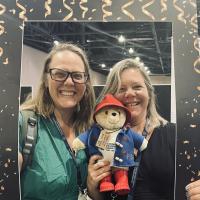
Marianne's highlight was reacquainting herself with the beautiful mathematics of algebraic correspondences, co-developed by her former PhD supervisor Shaun Bullett, in a brilliant talk by Luna Lomonaco and Sabyasachi Mukherjee. And both of us were thrilled to appear on-stage in conversation with Abel Prize Laureate Karen Uhlenbeck at the Abel Prize Reception. Uhlenbeck was only the second woman to give a plenary lecture at an ICM, in 1990. The first was Emmy Noether in 1932, just 58 years earlier.
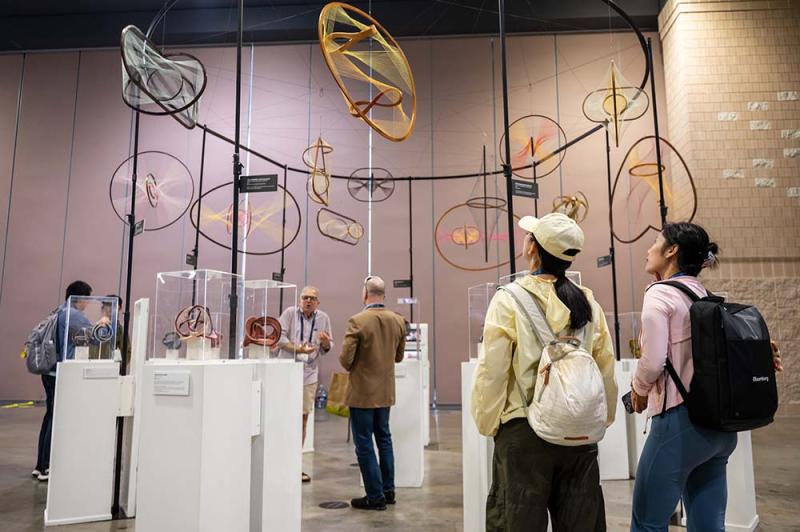
A highlight mentioned by many attending the ICM was the art and music that was on offer. An organ performance by mathematician Daniel B. Forger thrilled all those who made it over to the beautiful Cathedral Basilica of Saints Peter and Paul. Clemency Montelle and 2014 Fields Medallist Manjul Bhargava looked at mathematics in ancient Indian culture. Montelle's talk explored Sanskrit poetry, whose weaving together of syllables inspired some serious combinatorics. Bhargava talked about a new mathematical result that was inspired by the Chautisa Yantra, a (very) magic square that can be found on the Lord Parshvanath Jain Temple in the city of Khajuraho. Both examples show that mathematics in ancient India was firmly rooted in the arts.
As we rode around Philadelphia on a tourist bus on our last day, we mused about the various roles that mathematics has played in human culture and about what the future may hold in store. We kept coming back to a quote we heard mentioned several times during the Congress. It's from the great Bill Thurston: "Mathematics only exists in a living community of mathematicians and breathes life into ideas both old and new."
About this article
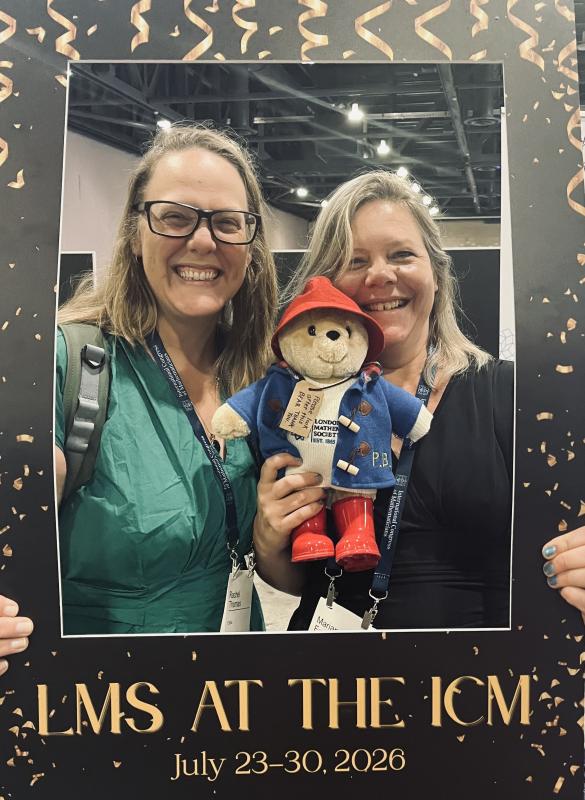
Marianne Freiberger and Rachel Thomas are Editors of Plus. They attended the 2026 International Congress of Mathematicians in Philadelphia in collaboration with the London Mathematical Society and with kind support of the Institute of Mathematics and its Applications.