

Water, ice and broken symmetry
Brief summary
This article looks at phase transitions and their relation to symmetry breaking. It is the first of a three part series looking at the rise of category theory in physics.
When you're trying to understand something it's tempting to take it apart. That's what children do, and it's also what physicists do when they look at the fundamental constituents of matter — electrons, quarks and the like.
There are things, however, you can only understand on a collective level. An example occurs every time you put your ice cube tray into the freezer. The individual water molecules remain as they are, but their arrangement changes so drastically that something you could swim in turns into something so hard you could hit someone over the head with it. This change happens rather suddenly when the water reaches the temperature of 0 degrees Celsius. It's an example of a phase transition: the water changes from the liquid phase to the solid phase.
There are other examples of phase transitions too, such as magnets suddenly losing their magnetisation when heated up, and liquid helium cooling down into a superfluid. Even the entire Universe is thought to have undergone a phase transition when it was very young, a process which crystallised the fundamental forces and particles as we observe them today.
What brings about these sudden changes? Back in the 1930s the physicist Lev Landau realised that the concept of symmetry has a lot to do with it. Luckily mathematicians had been developing a language of symmetry, called group theory, for quite some time. Originally motivated by problems in pure mathematics (whether you can solve certain equations) this language came to play a prominent role in twentieth century physics.
Nearly a hundred years on and it's turned out that ordinary symmetry is no longer enough. People have discovered exotic materials — new phases of matter — whose properties defy what group theory can capture. These are materials we'd very much like to understand. They might help us build quantum computers, for example. A new language is needed, and once again, pure mathematics has obliged, providing us with category theory — a formalism that had previously been described as "abstract nonsense".
The mathematical objects involved can be seen as a form of generalised symmetry. "There are phases of matter that cannot be distinguished by just looking at symmetries," says Frank Verstraete, Leigh Trapnell Professor of Quantum Physics at the University of Cambridge. "This is the key: you need these generalised symmetries."
Verstraete was one of the organisers of a research programme called Quantum field theory with boundaries, impurities, and defects, which took place at the Isaac Newton Institute for Mathematical Sciences (INI) in Cambridge last year. One of the most important insights of the programme, according to Verstraete and his colleagues, is just how important category theory is becoming in our understanding of materials. A prominent participant of the programme was Liang Kong, Research Fellow at the International Quantum Academy and expert in applying category theory to physics. Verstraete and Kong talked to us at the INI when the programme was in full swing.
Why symmetry?
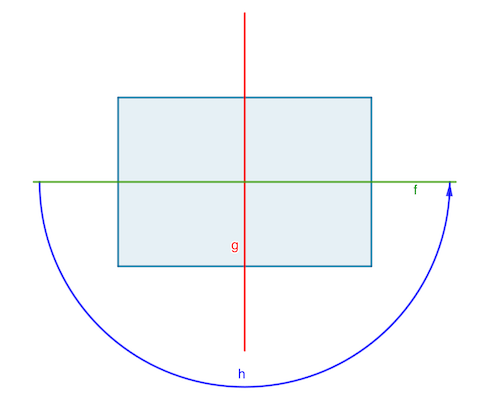
Symmetry is immunity to change. A picture of a butterfly contains a mirror symmetry: when you reflect it in the central axis, the picture doesn't change. A rectangle also displays mirror symmetry with respect to the vertical and horizontal axes. And it's got rotational symmetry as well. If you stick a needle into its central point and spin the square around by 180 degrees, it will look the same.

To see why symmetry is important in phase transitions, imagine looking down at a pot of water. It's full of water molecules. Thermal energy makes these particles rotate, vibrate, and move around, randomly bumping into each other. If you could see the individual molecules, what you'd see is random disorder. The disorder can be measured using statistics. If you rotated the pot through any angle the measured value of disorder wouldn't change. In this statistical sense, the system is highly symmetric.
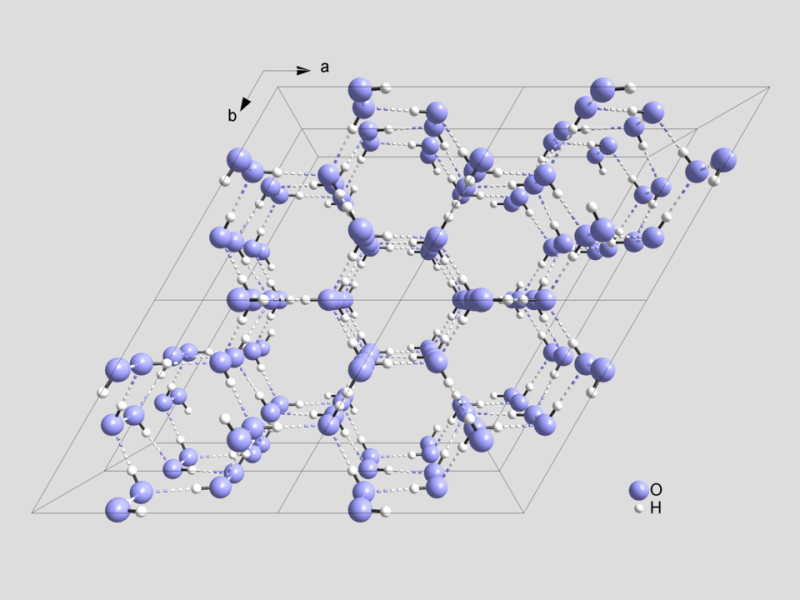
When the water freezes to ice, the molecules lock into a rigid lattice. The lattice has a hexagonal structure — if you rotate it, it won't generally look the same as before, unless you rotate it through particular angles. When the water froze to ice, the high degree of symmetry disappeared. To use the language of physicists, the symmetry was broken.
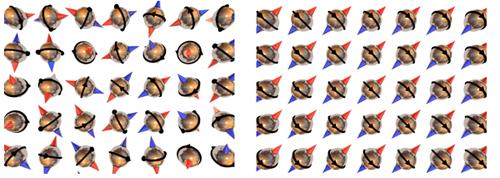
A similar change — from a highly disordered, highly symmetric state to a more ordered, less symmetric state — happens when a material, such as iron, undergoes a phase transition which turns it into a magnet. You can think of individual particles as little bar magnets, each with its own south and north pole. Neighbouring particles want to align their poles, but at high temperatures, thermal energy jostles them about, preventing them from doing so. At these high temperatures the picture is disordered and, like the pot of water molecules, highly symmetric.
When the material cools down to below a critical temperature, the interaction between neighbouring particles is able to dominate the thermal energy so particles align. A global magnetic field appears and the symmetry breaks. The temperature at which this happens is called the Curie temperature, after Pierre Curie, husband of the famous Marie Curie. For iron the Curie temperature is 770 degree Celsius (you can see the Curie temperatures for other materials in this table.)
Until the 1980s people thought that all phases of matter can be described in terms of symmetry breaking. Once a system becomes sufficiently ordered the symmetry associated with its disorder breaks and the material changes its nature.
"The real motivation for [a change of viewpoint] was the [discovery of the so-called quantum Hall effect]," says Verstraete. "That was a really big thing at the beginning of the 1980s."
To find out more about this truly curious phenomenon see the next article.
About this article
Liang Kong is Research Fellow at the International Quantum Academy.
Frank Verstraete is Leigh Trapnell Professor of Quantum Physics at the University of Cambridge. You can find out more about his work in this article and about a popular book on quantum mechanics he has co-authored in this podcast.
Verstraete was one of the organisers of a research programme called Quantum field theory with boundaries, impurities, and defects, which took place at the Isaac Newton Institute for Mathematical Sciences (INI) in Cambridge in 2025. Kong was one of the participants.
Marianne Freiberger, Co-Editor of Plus, interviewed Verstraete and Kong in November 2025.
This article was produced as part of our collaboration with the Isaac Newton Institute for Mathematical Sciences (INI) – you can find all the content from the collaboration here.
The INI is an international research centre and our neighbour here on the University of Cambridge's maths campus. It attracts leading mathematical scientists from all over the world, and is open to all. Visit www.newton.ac.uk to find out more.
