
Building bridges between modelling and policy
Mathematics and politics are not often mentioned in the same breath. But when mathematical modelling informs policy — as is the case with climate science, the economy, and epidemiology, for example — these two very different worlds collide. These two worlds speak very different languages – which makes communication between them difficult. One speaks the language of mathematics, and is concerned with the limitations, assumptions and uncertainty inherent in these simplified descriptions of the world around us. The other wants definitive options, concrete answers and evidence on which to base decisions impacting real people's everyday lives.
A mathematical model is a description of a process in the world around us in terms of mathematical expressions. You can use the model to get an idea of how the process may play out, or how this might change if circumstances change.
You can find out more, including how models are used, here.
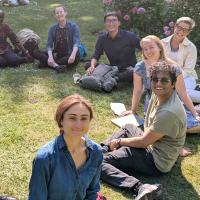
Earlier this year, Liza Hadley, a post-doctoral researcher jointly affiliated to CU Boulder and the University of Cambridge, organised a workshop that brought together researchers from around the world to explore how modelling is translated and used in policy-making. “We were all working on the same thing,” she explained. “But many of these groups didn’t know each other. The idea was to bring them together.”
The first day of the workshop was open to the wider research community, with 50–60 attendees learning about studies conducted around the world into the interaction of modelling and policy. Speakers came from Australia, Thailand, Kenya, Germany, Switzerland, the United States, as well as the UK, giving a global perspective on this area of research.

The second day focused on comparing and contrasting those studies, building on the live notes and a mind map that had captured ideas presented on the first day. “There was a good amount of evidence presented about how modelling is currently used in policy making,” Hadley said. "There was a consensus that we now have a solid evidence base and consistent suggestions for improving relations between modelling and policy." Now the next step is to put these suggestions into action.
One such suggestion for action is to develop training for modellers — such as a stand alone 1-2 hour module that could be added on to existing skills training. The aim of this would be to equip modellers with proven strategies for communicating and collaborating with people working in policy, and navigating the structural and cultural differences between academic and policy settings.
There is also scope for future research, particularly reflecting on where translation of modelling into policy hasn't been successful. “So far we’ve looked at where modelling worked. But what about where it didn’t, where modelling isn't used?" said Hadley. Yoonie Sim, from the World Health Organisation (WHO), presented one example where this is already being done. By reviewing where modelling is, and is not, being used in making decisions about immunisation, WHO is developing guidance for what work needs to be done (you can read more in this paper).
The other key theme that emerged from the workshop was funding. In her presentation, Epke Le Rutte, from the Swiss Tropical and Public Health Institute, highlighted that we are already in the next public health emergency – but this time it is a rapid reduction of healthcare funding, such as in diseases like malaria. "With the current political climate, the global funding of public health research is expected to change significantly over the coming years," Hadley and her colleagues wrote in their report. In the face of this emergency, it is vital to understand how existing scientific and modelling expertise can be translated in a way that is most useful for policy makers.
From equations to conversations
What was particularly unusual about this workshop was that it brought together qualitative research into how the very quantitative evidence from mathematical modelling was used in policy and decision making. Indeed it was the first workshop focussing on qualitative research that JUNIPER, the partnership of disease modellers from across the UK, had supported.
This bridge between research approaches is exemplified in Hadley’s own research journey. She began working in a very quantitative way, moving from a mathematics degree from Oxford University to working at the London School of Hygiene & Tropical Medicine (LSHTM). But when she moved onto a PhD in infectious disease modelling at the University of Cambridge she found herself asking questions that maths alone couldn’t answer. "I began to ask, how is modelling done? How do you do it well? These questions need a qualitative approach."
And the first thing she noted about this shift from quantitative to qualitative research was that you get stuck in a completely different way. "If you get stuck on a question in mathematics you know lots of things you can try. For example you can try to generalise, or start with the case of n=1 and go from there." In contrast, after a concrete start in her PhD, with a paper arising from an INI remote programme in 2020 identifying challenges to the interaction between modelling and policy, it was very hard to know what to do next.
Eventually, she designed a multi-country interview study involving modellers and policymakers, focusing on COVID-19. “We looked at structures, communication, collaboration, and evaluation. It was about learning lessons and looking forward.” And it was during this and subsequent work during her PhD that she met many potential speakers for the workshop and began to build this community of those researching the interactions between modelling and policy.
For many coming from a background in quantitative research, it is fascinating to learn about how a comparable rigour is achieved in qualitative research. “We record conversations so they’re accurate, transcribe them so individuals can check, and do parallel analysis with at least two members of the research team. We share results back to interviewees to make sure they’ve been interpreted correctly.” And when this research is published in journals it is important to report as much detail as possible so that the study is reproducible both in its conduct and analysis.
Hadley also brings to her research the advantage of her own modelling background. “They [the modellers] were being interviewed by someone also in the modelling ecosystem," Hadley said. "I’m not looking to criticise, I want to know what we can learn. That gave a growth mindset to all the interviews.”
Qualitative research, even about mathematical modelling, is often written in a very different language. But her background meant her work was published in modelling journals, where it can reach the very audience it’s meant to serve. “The research was for modellers. I used the language modellers speak—and I speak.”
Looking Ahead

The report from the workshop is now available on Open Science Framework, and includes links to all the research presented at the workshop. Hadley and her colleagues are also bringing together the outcomes from the workshop in a comment article that will be published soon.
As for her own future research, Hadley is interested in exploring the intersection of economics and epidemiology, especially in countries like South Africa where there were pre-existing relationships between modellers and policymakers due to work on budgeting for efforts combating HIV. These established relationships helped shape effective responses in the pandemic and Hadley is interested in understanding how these two areas come together, both mathematically and also qualitatively and culturally. She has also been considering the different actors that make up a government, and connecting with vision science experts to plan future works.
Ultimately, Hadley’s work is about connection—between disciplines, between people, and between theory and practice. “This is a new and emerging area,” she said. The workshop was an important step in bringing this research community together. Modellers are aware of the work in their own groups and areas, but there’s a gap in formal evaluation using qualitative methods. "We need to link up across countries and across these qualitative and quantitative approaches.”
About this article
Liza Hadley is a postdoctoral researcher jointly affiliated to CU Boulder and the University of Cambridge, and an Affiliate member of JUNIPER, the Joint UNIversities Pandemic and Epidemiological Research network.
Rachel Thomas is Editor of Plus.
This article is part of our collaboration with JUNIPER, the Joint UNIversities Pandemic and Epidemiological Research network. JUNIPER is a collaborative network of researchers from across the UK who work at the interface between mathematical modelling, infectious disease control and public health policy. You can see more content produced with JUNIPER here.
