
Maths goes to Parliament
The Maths Week Parliamentary Expo
This week saw the release of Grand Theft Auto 6, ending a 13-year wait for gamers who have bought more than 24.5 million copies so far.
"This is not just a video game moment. It's a cultural moment," said Chris van der Kuyl, Chairman of gaming company 4J Studios (of Minecraft fame). "This is an entertainment revolution underpinned entirely by mathematics."
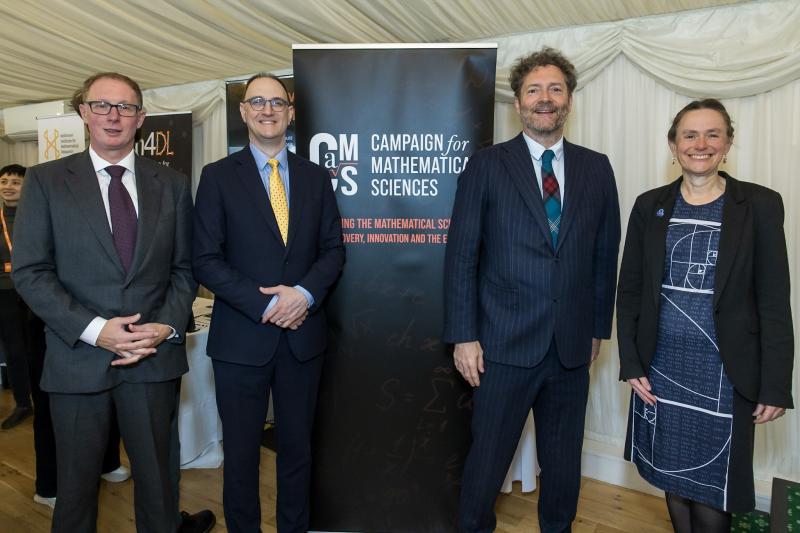
Van der Kuyl was speaking, not at a gaming convention, but at the UK House of Commons for the 2026 Maths Week Parliamentary Expo. Hosted by Ian Sollom MP, the event aimed to show how important the mathematical sciences are for research, innovation and prosperity.
Computer games are indeed based heavily on maths (see here for an example) and the financial clout of Grand Theft Auto alone is impressive. "This one video game was invented by a bunch of geeks from Dundee who stayed in Dundee," said van der Kuyl. "Somewhere in the region of 50% to 60% of the 1.5 estimated billion Sterling spent on this game has been spent here in the UK." The video gaming industry body UK Interactive Entertainment put the value of the entire sector at £8.76 billion in 2025, estimating it supported more than 73,000 jobs.
More generally, the contribution of all of the mathematical sciences to the UK economy runs to around £500 billion a year, according to Sollom. With this they form around 20% of the UK Gross Value Added. This input comes from a broad range of industries. Organisations represented at the event included the Met Office, Neuronostics (a company working to transform epilepsy care), Oscar-winning visual effects and animation company DNEG, data privacy company Pimloc, and defence and aerospace company Leonardo.
When it comes to the research that underlies mathematical innovation the UK is internationally leading. "We have 4% of the global mathematical sciences researchers, and those 4% produce 14% of highly cited research papers," said Helen Wilson, Director of the Isaac Newton Institute for Mathematical Sciences. "We punch well above our weight."
Despite these figures, mathematics isn't safe. In recent years, cuts to university funding have had a brutal impact on maths departments. "There are mathematics departments closing down across the country," said Wilson. "[There's a] potential for maths deserts, places where kids who are not able to leave home to go to university simply cannot study mathematics."
Closures of maths departments mean less immediate talent for maths-reliant industries and fewer specialist maths teachers to inspire the next generation. "That's a real concern," said Wilson. "[We need] policy to modify those situations so that those departments don't close, because their place in the pipeline is so important."
Treating spending on maths as a short-term cost rather than a long-term investment is likely to back-fire, said Mark Daniell of Leonardo, because experts can't be pulled out of a hat. "Talent cannot be bought in a crisis. A world class mathematician takes years to nurture and develop. If we wait until we need them, we're already too late." In defence, he said, the rationale for investing in mathematics is simple: "the side with the best equation usually wins."
Ironically, the fact that mathematics is so widely applicable also means it often remains hidden. There are many mathematicians working in industry, but few have the word "mathematician" in their job title. The aim of the Maths Week Parliamentary Expo is to bring the power of maths out into the open: to raise awareness among those who decide on future policy and funding.
The Maths Expo is now in its third year, but since last year's edition the world of mathematics has seen upheaval on a seismic scale. In the last few months, artificial intelligence appears to have gained the ability to solve very hard maths problems, even problems that were considered beyond human reach.
The power of AI presents unprecedented opportunities. Several of the organisations represented at the Maths Expo are busy exploiting those. They include our friends from the Maths for Deep Learning research project, who are not only building theoretical foundations of AI, but also developing applications, for example in medical imaging, weather forecasting, and even the preservation of cultural heritage.
The rise of AI in maths also presents challenges, however. If artificial intelligence becomes superhuman at solving individual problems, then some of the goals, structures, and processes of human mathematics will need to adjust. But this doesn't make human mathematicians expedient. "If answers become cheap, understanding becomes more valuable," said Sollom. "And that understanding doesn't appear from nowhere." Politicians would do well, he suggested, to listen to the mathematical community's responses to AI developments.
And since AI is made of mathematics, human mathematicians are also needed to direct its deployment and development. As Daniell put it in relation to the maths used in defense, "If we own the algorithms, as the United Kingdom, we own the capability."
The Maths Week Parliamentary Expo is organised by the Campaign for the Mathematical Sciences (CaMS), which was founded in 2021 in response to the closure of the Pure Mathematics Department at the University of Leicester. Its aim is to advance the mathematical sciences for discovery, innovation and the economy by supporting engagement and providing specialist advice in maths policy.
Van der Kuyl became involved with CaMS when he heard that his own alma mater, the University of Dundee, was going to shut its undergraduate maths degree programme. With the help of the CaMS he published an eye-opening letter in the Financial Times earlier this year. The university later decided to keep its maths degree running, at least for now.
Back in the 1990s, van der Kuyl helped to set up the world's first Masters, and later undergraduate, degree in computer games, at Abertay University, also in Dundee. He fought hard to have serious mathematics be a central component of the degree courses. Because as he said at the end of his speech, "without maths, I wouldn't be standing here today talking to you. And without maths, I don't think this country has a bright future."