
Artificial intelligence and mathematical proof
This summer has seen rapid advances in artificial intelligence solving hard, and iconic, mathematical problems. The developments are exciting to some mathematicians, but others worry about what they mean for the future of the field.
The following content looks at some of the questions AI has solved, how it can be a help, and what mathematicians have been discussing.

A millennium problem solved by AI?
On September 8th, 2026, OpenAI announced that one of its systems had solved the Navier-Stokes Millennium Problem. But has the problem really been solved? What exactly was the contribution of AI? And what does the advance of AI on mathematics mean for the field? We talk to mathematician Chris Budd to find some answers.

AI versus mathematics?
We talk to mathematician Henry Bradford about one particular result AI has proved and discuss the mathematical community's response, issues surrounding who should be credited, and what developments might mean for young mathematicians and the future of the field.
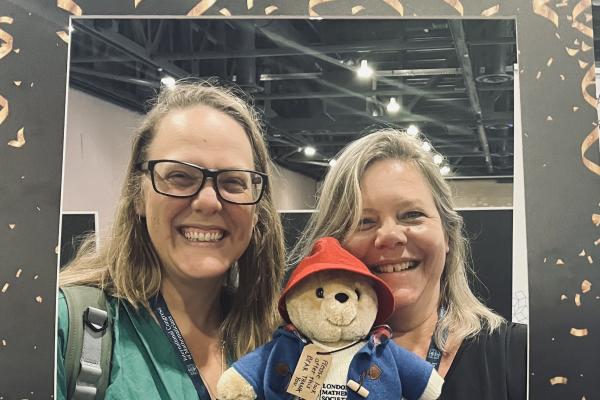
ICM 2026: A postcard from Philadelphia
AI was a major talking point as this year's International Congress of Mathematicians (ICM) with one mathematician even announcing that some parts of mathematics are bound to die. We recount our experiences from the ICM.

Enter the centaur
Mathematician Geordie Williamson explains how mathematics is entering a "centaur phase", where some of the best results come as a collaboration between humans and AI.

The murmuration conjecture: finding new maths with AI
In this article from 2024 mathematician Yang-Hui He explains how an exciting new conjecture came about through a collaboration between artificial and human intelligence. It's an example of the doors that AI can open.
Plus at the Heidelberg Laureate Forum
Every year we attend the Heidelberg Laureate Forum (HLF), where early career mathematicians and computer scientists meet some of the best minds in their field. The role of AI in mathematics was hotly debated at this year's HLF. The following two videos contain young researchers' reactions as well as opinions and advice from established researchers.