
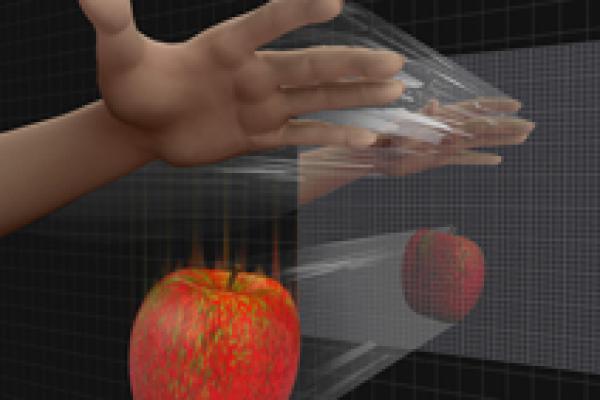
Quantum gravity in the can: The holographic principle
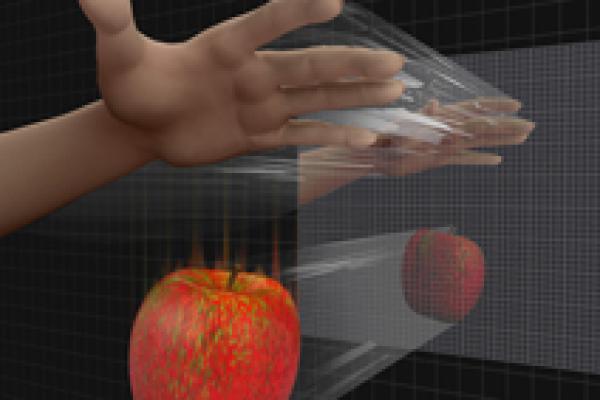
It might sound like something from science fiction, but the holographic principle might help us answer the biggest problem in modern physics.

Marianne Freiberger is Editor of Plus. She joined Plus in 2005 after doing a PhD and then a three year postdoc at Queen Mary, University of London. As a researcher she worked in complex dynamics, the area of pure maths that has given us the Mandelbrot set. In the world of maths communication she has been Editor-in-Chief of the Mathscareers website, given presentations to mathematicians about how to communicate their work to a wider audience, and to journalists about how to deal with maths in the media. She has been a TEDx speaker and an invited speaker at the International Congress of Mathematicians in 2010.
Together with Rachel Thomas, Marianne has co-authored several popular maths books including Numericon: A journey through the hidden lives of numbers and Understanding numbers, and were editors on the book 50: visions of mathematics. They were Science Editors for the Discovery+ documentary series Universe Unravelled about the work of the Stephen Hawking Centre for Theoretical Cosmology.
In October 2022 Marianne and Rachel received a SPI-M-O Award for Modelling and Data Support (SAMDS) from the UK's Scientific Advisory Group for Emergencies. This award recognised their work with the JUNIPER modelling consortium to provide a wide audience (including public, press, policy makers and government) with clear and accessible explanations of some of the maths that was vital in responding to the COVID-19 pandemic.
It might sound like something from science fiction, but the holographic principle might help us answer the biggest problem in modern physics.

You can explore how we might extend our model but running your own epidemic with our Lucky Dip interactivity. Follow along with Julia as she paves the way to a model that is very similar to the mathematics disease modellers use every day.
In Part 3 Julia refines our model to use one of the most important numbers in disease modelling. And there's a chance for you to explore its meaning using a new interactivity.
In the final Part we explore what other aspects we need to consider to make a model more realistic. There's an interactivity that allows you to party, commute, and visit friends and we find out more about what life as a research is like from Julia.
In this final part, you can meet the researchers themselves and find out about the real research questions that Julia and some of her colleagues are working on!
Could AI help judges deliver fair and transparent sentences? A recent study group involving law experts and mathematicians explored the challenges involved.
We continue our exploration of the potential use of AI in sentencing.
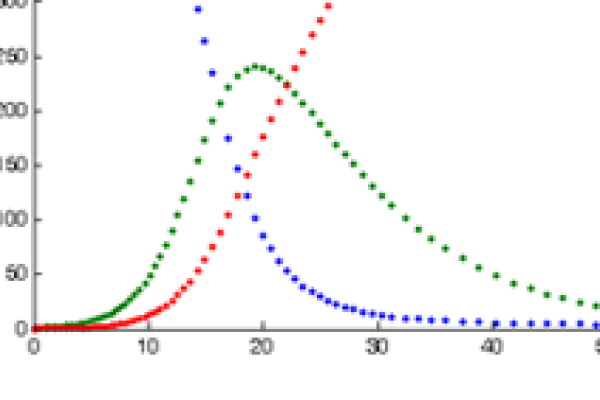
At the beginning of an epidemic the number of infected people grows exponentially. But why does the number e appear in descriptions of this growth?
How can we use mathematics to model the spread of a disease?
The doubling time of a disease is the time it takes for the number of cases of the disease to double. How do you calculate it?