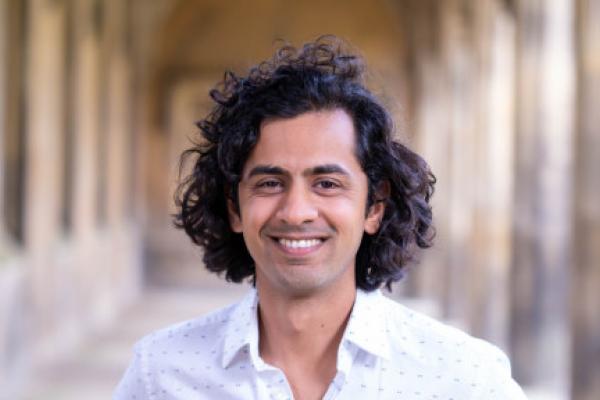

Cambridge appoints first-ever Hawking Professor of Cosmology
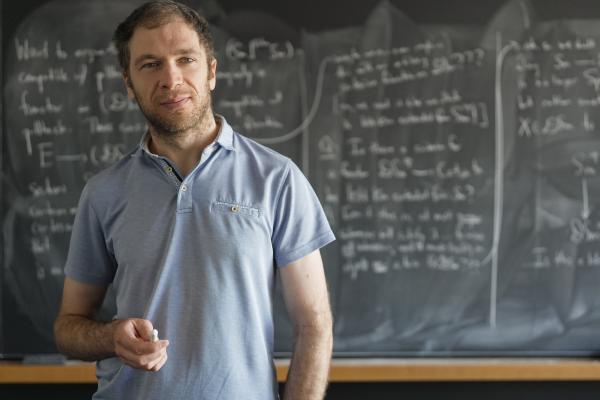
Daniel Baumann will be treading in Hawking's legendary footsteps, pursuing a central question of the field: How did the Universe begin? Find out more in this article.
Marianne Freiberger is Editor of Plus. She joined Plus in 2005 after doing a PhD and then a three year postdoc at Queen Mary, University of London. As a researcher she worked in complex dynamics, the area of pure maths that has given us the Mandelbrot set. During her time as a researcher she also held various teaching engagements. In the world of maths communication she has been Editor-in-Chief of the Mathscareers website, given presentations to mathematicians about how to communicate their work to a wider audience, and to journalists about how to deal with maths in the media. She has been a TEDx speaker and an invited speaker at the International Congress of Mathematicians in 2010.
Daniel Baumann will be treading in Hawking's legendary footsteps, pursuing a central question of the field: How did the Universe begin? Find out more in this article.
Causal inference is the art of discerning cause and effect from data. Find out more in this introduction.
How do you discern cause and effect when you can't do a controlled experiment? Directed acyclic graphs (DAGs) are a fun and important tool.
Why was the 2025 Atlantic hurricane season different from previous seasons? Early career researcher Charles Powell analysed the data, helping insurance company Inigo in the process.
Infectious diseases in hospitals cost lives and money. How can we best understand them?
Find out how deep learning can help improve the images produced by MRI, CT and PET scans, making patients more comfortable and cutting NHS waiting lists.
This year's Abel Prize has been awarded to the German mathematician Gerd Faltings for work that brings together number theory and geometry to solve equations.
A short explanation of the fundamentals of category theory.
Category theory, which has previously been described as "abstract nonsense" turns out to be just the language we need to describe materials that may help us build quantum computers. Find out more in this article.
The quantum Hall effect is a curious phenomenon: not only does it make effects from quantum physics visible in the macroscopic world, it also links physics to the pure mathematical area of topology. Find out more in this article.
What does water feeding to ice have to do with symmetry? This article provides an answer and begins to tell the astonishing story of how theory once denounced as "abstract nonsense" may help us build quantum computers.
Gravitational waves have provided a wealth of information about black holes. But could other objects be hiding in this data too? Researchers are exploring this idea, which may also help resolve the mystery of dark matter.